Product Details
Welcome to Guangzhou Wellcare Silicone Products Co., Ltd. official website!
- Scan for Mobile Store

Liquid silicone molding, clean-room assembly, charging module integration



Price¥0.35
MOQ5000 pieceStock:0 piece
 Company Card
 Silicone Baby Bib and Placemat Ma
¥1.80/piece
 Silicone Gasket, Valve and Diaphr
¥0.09/piece
 Body Safe Silicone Components Sho
¥0.55/piece
 Platinum Silicone Personal Wellne
¥1.45/piece
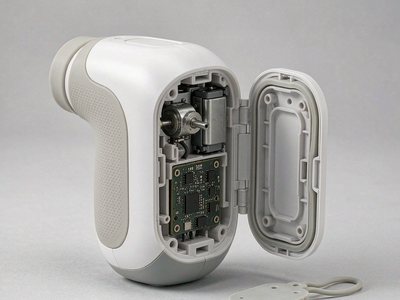 IPX7 Rechargeable Personal Massag
¥6.80/piece
 UV Stabilized Garden Hose Reel an
¥6.50/piece
Massager Motor Mount and Vibratio
¥0.35/piece
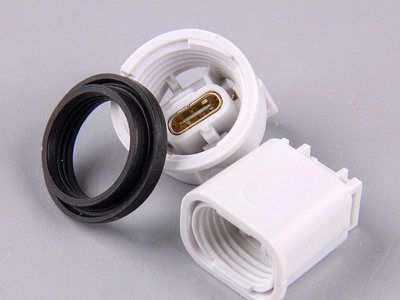 USB-C Charging Port Insert Mouldi
¥0.68/piece
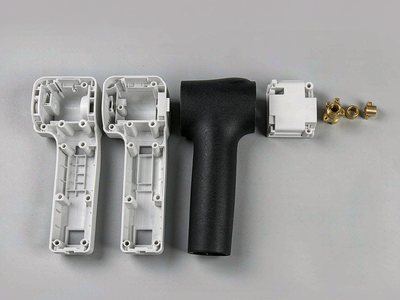 Recovery Massage Gun Housing and
¥2.80/piece
The visible half of a massager is the housing; the half that decides whether the device survives its second year is the internal mount. The motor is the heaviest component, it reciprocates at the frequency the whole product is named after, and it is held to the housing by moulded parts. When the mount fails, the failure is invisible until the device rattles, overheats, or walks across the table, and by then the warranty cost is the entire device.
We mould motor mounts, damping inserts and counterweights for personal massager and wellness device programmes.
A massager motor is an offset mass on a shaft, and everything it touches receives that imbalance as a periodic force. The mount has two jobs that pull against each other: hold the motor tight enough that the alignment does not drift, and isolate the housing enough that the user does not feel the vibration as noise or heat. The usual answer is a two-layer mount: a rigid boss that carries the position and a TPE layer that carries the isolation, with the TPE durometer chosen so the mount's natural frequency sits away from the motor's running frequency rather than on it.
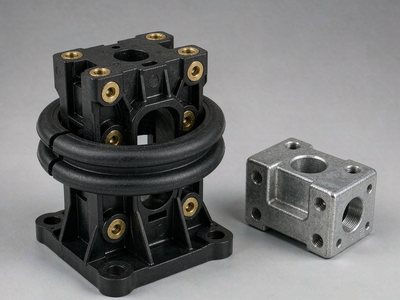
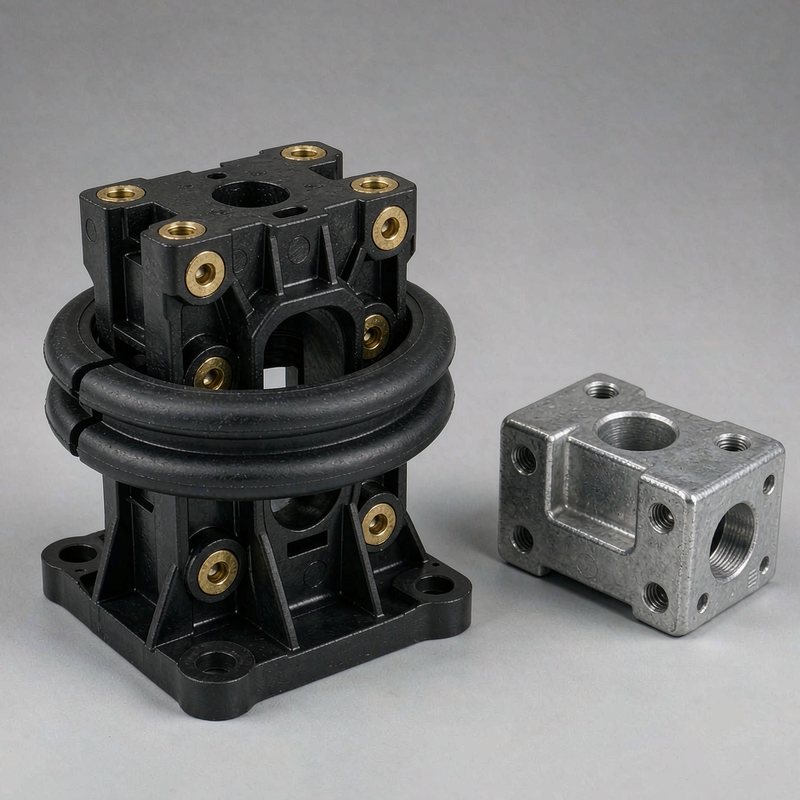
The motor bolts to brass or steel inserts moulded into the mount, because a plain ABS boss strips under the assembly torque and a plain ABS bore ovalises under the reciprocating load within a season. The insert has to be held in the tool without flash over the thread, the shot has to fill around it without a weld line at the root, and the part has to cool without pulling the insert out of square. First articles are pull-tested and torque-tested with the break mode reported, because an insert that pulls clean was under-supported in the tool, and no material change fixes it afterwards.
| Motor mount | ABS with brass or steel inserts, two-layer with TPE isolation |
|---|---|
| Damping insert | TPE 40 to 70 shore A, per frequency target |
| Counterweight | Moulded-in shot or zinc insert, per balance spec |
| Retention | Pull and torque verified per lot |
| Isolation | Natural frequency stated per programme |
| Packing | Bulk with lot card, kitted to device BOM |
| MOQ | 5,000 pieces per part number |
The damping layer is quoted against a frequency target rather than a durometer, because the same durometer isolates differently on different mount geometries. We ask programmes for the motor's running frequency and the mount's available space, and we quote the TPE grade that puts the mount's natural frequency away from the running frequency. Where a programme has no measured data, we quote a default isolation layer and supply the mount for a bench check before the full order, because a mount that resonates amplifies rather than damps, and the amplification is audible to the user on the first use.
Where the programme targets low noise rather than isolation, the mount carries a counterweight that balances the motor's offset mass, and the weight is either a moulded-in shot channel or a zinc insert. The balance is a measured specification: we quote the residual imbalance the programme states and verify it on a sample basis, because an unbalanced mount does not fail; it just makes the device feel cheap, which in this category is the same thing.
Device internals declare to CE and RoHS as the programme requires, with the compound declaration covering the ABS, the TPE and the insert metal separately. As across this whole category, the copy and the parts carry no medical or therapeutic claim: these are fitness and consumer device components in every market we ship to, and the programme's marketing owns whatever claims sit on top of the device. The declaration file is built to support a consumer-device route, not a medical one, and we say so in writing when a programme asks for the medical version.
Our massager housing programme covers the visible half of the device, and the wellness device category lists the full range.
Tel:
Mobile:
Email:
Address: Panyu District, Guangzhou, Guangdong, China
WeChat Support
Mobile Store
