







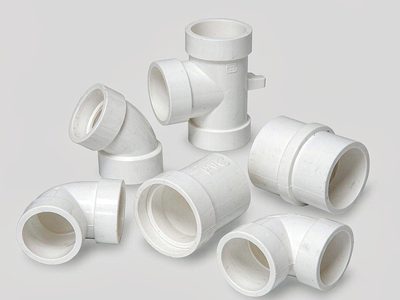

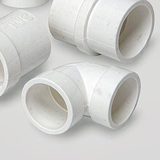
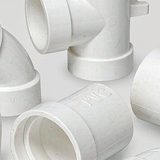

A PVC pipe fitting manufacturer produces the joints, bends, tees and reducers that hold a drainage or water line together, and the joint is usually where a system fails first. Two fitting families dominate: solvent-weld fittings, where a chemical bond fuses pipe and socket into one material, and rubber-ring push-fit fittings, where a gasket does the sealing and the joint stays demountable. Specifying the wrong family for the installation conditions is a more common error than specifying the wrong size.
UPVC and CPVC Are Not Interchangeable
- UPVC — the standard for drainage, waste and vent, plus cold water distribution. Good chemical resistance, low cost, service temperature up to roughly 60 C.
- CPVC — chlorinated, higher temperature ceiling and better resistance to some hot chemical streams. Costs more and needs its own solvent cement; mixing cements between the two families produces a joint that looks sound and fails under pressure.
Joint Types and Where Each Belongs
Solvent weld gives the strongest, most rigid joint and the lowest material cost. It requires correct clearance between pipe and socket, the right cement for the diameter, and a defined cure time before pressure testing. It cannot be dismantled.
Rubber ring push-fit allows thermal movement and quick assembly, which matters on long buried runs and on sites where weather stops solvent work. The gasket is the critical part: lubricant compatibility and correct insertion depth decide whether the joint holds.
Flanged and threaded connections are used at equipment interfaces. Threaded PVC needs moulded threads, not cut threads, or the wall thins and cracks at the root.
Sizing, Pressure Class and Standards
Fittings must match the pipe schedule, not just the nominal diameter. A fitting rated for Schedule 40 in a Schedule 80 line becomes the weakest point in the system. Common reference standards are ASTM D2466 and D2665 for UPVC drainage and pressure fittings, and EN 1329 for soil and waste applications in Europe. Ask which standard the mould was designed to, since dimensions between standards differ at the socket depth.
Inspection Points Buyers Miss
- Socket depth and taper — short sockets pass a visual check and fail a pressure test
- Wall thickness at the crotch of a tee, where moulded wall is thinnest
- Colour and opacity consistency, which signals regrind ratio drift
- Gasket hardness and seating, on push-fit ranges
Send the pipe schedule, the joint type, the service medium and the reference standard. For projects that mix materials, compare the HDPE pipe fitting range as well — fusion-welded HDPE behaves very differently from solvent-welded PVC on buried and seismic-sensitive lines. Suppliers able to document both the standard and the regrind policy are listed among plastic products manufacturers and verified companies.
