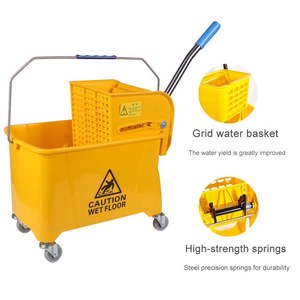
The wringer decides the bucket
A mop bucket has two jobs and only one of them is holding water. The other is squeezing a mop head hard enough that the floor dries in minutes rather than hours, and doing it ten thousand times without the mechanism stripping or the wall bowing out.
Buyers who compare buckets on litre capacity and price are comparing the easy half. The press mechanism, the wall section behind it, and the castor mounting are where a cheap bucket becomes an expensive contract, because those are the parts that come back.
Body: a deep draw in copolymer PP
The body is a deep, thin-walled draw — 20 L to 25 L, 300 mm or more deep, with a taper that has to be gentle enough to hold volume and steep enough to release from the core. That combination sets the resin choice.
- Copolymer PP, MFI 10–15 g/10 min. The flow length from a centre gate to the far top corner is long, and the wall is only 2.5–3.5 mm. Lower flow grades short-shot at the rim; much higher flow grades give a body that dents permanently under a full load.
- Impact copolymer, not random. Random copolymer is clearer and stiffer but brittle at low temperature. A bucket left in a service cupboard over winter is a bucket that gets dropped at 5 °C.
- No regrind in the rim. Regrind is acceptable in the base and lower wall, but the top rim carries the wringer and the handle pivots. Regrind there is where stress cracking starts.
Wall thickness is a compromise the moulding supplier will want to move and the buyer should not allow: below 2.5 mm the body oil-cans when full and the wringer mounting pads flex; above 3.5 mm the cooling time rises sharply and warpage at the rim makes the lid and wringer sit proud.
Why the rim is a structural member
On a side-press bucket, the press is mounted on the rim and the reaction force goes straight into the wall behind it. A typical side-press delivers roughly 200–400 N at the mop head, and that force is applied as a bending moment on a 300 mm tall wall.
Three details keep the wall from bowing:
| Detail | What it does | Typical value |
|---|---|---|
| Perimeter rim flange | Turns the open top into a ring beam | 6–8 mm wide, 4–5 mm thick |
| Vertical ribs on the press side | Carries the moment down to the base fillet | 3–4 ribs, 0.6× wall |
| Press mounting pads | Spreads load, prevents point cracking | 4 pads, bossed, radiused at the root |
A bucket with a flat rim and no ribs will still work in a showroom. It fails in month four, when the rim has taken a permanent set and the wringer no longer seats squarely — and a wringer that sits at an angle tears mop heads.
The mechanism: gear ratio, ratchet and the parts that wear
Side-press and down-press wringers both convert a short handle stroke into a high-force, short-travel squeeze. The design questions are the same for both.
Gear ratio. The handle moves 150–200 mm and the press plate travels 40–60 mm. A ratio between about 1:3 and 1:5 gives a press force a cleaner can generate repeatedly without the bucket walking across the floor. Higher ratios feel impressive once and are tiring by the twentieth mop.
Materials. The gear pair is the wear surface, and it should not be the same material on both sides:
- POM gear, POM or PA6 rack. POM is self-lubricating and keeps its tooth form under repeated load. PA6 is tougher but absorbs moisture and grows, which changes the mesh.
- ABS for cosmetic covers only. ABS is common on wringer housings because it takes a good finish. It is also the part that cracks when a bucket is dropped, so a housing that carries load in ABS is a warranty claim in waiting.
- Steel where steel belongs. Pivot pins and the ratchet pawl spring should be stainless, not zinc-plated. A cleaning bucket lives in water.
Ratchet detent. The pawl that stops the plate springing back is the single most common failure on cheap wringers. Two checks matter: the engagement depth of the pawl tooth, and whether the pawl is a separate moulded part or a living-hinge finger. Living-hinge pawls fatigue and stop engaging; separate pawls with a stainless spring do not.
Cycle life. A commercial bucket sees 50–150 presses a day. Ten thousand cycles is a reasonable type-test target for a commercial grade, and it should be run wet, with a mop head in place, because dry cycling tells you nothing about wear in the presence of detergent.
Castors, handles and the loads nobody writes down
A 25 L bucket full of water is 25 kg, and the mop adds a lever arm when it is wrung. Design loads to check:
- Handle: static pull of 30 kg for 24 hours without permanent set. The failure is at the pivot boss, not in the handle bar.
- Castors: 4 castors at 30 kg each gives headroom over a 25 kg payload, which sounds generous until one castor takes the load while the bucket is tipped on a kerb. Specify castor dynamic load, not just "50 mm wheels".
- Castor mounting: stem-and-socket castors pull out. Threaded stems with a locking nut, or a moulded socket with a retaining clip, hold. This is the second most common field failure after the pawl.
Wheel compound follows the floor: PP wheels for warehouse and back-of-house tile, TPR or rubber-tyred for quiet areas and for floors that must not mark. For healthcare and food service, the colour-coded dual-bucket system is usually the requirement, and colour is a moulding decision — masterbatch in the same tool, not painted, because paint on a bucket that sits in water does not last.
Leaks: design them out rather than seal them
A bucket is one moulding, so it has no seam to leak — unless a drain plug has been added. Where a drain is fitted:
- Plug seat: a moulded conical seat with an EPDM O-ring, not a flat washer against a flat boss.
- Thread: coarse, 2-start, so it seals in a quarter turn and does not cross-thread when a cleaner is in a hurry.
- Location: at the lowest point of the base, with the base dished toward it. A drain above the low point leaves an inch of dirty water every time.
A bucket with no drain at all is easier to keep leak-free and harder to empty. That trade-off should be made against how the bucket will actually be used, not against catalogue features.
Tests to write into the order
Five checks, all run on production moulds rather than on a tool trial sample:
- Full-load handle test — 30 kg static, 24 hours, measure permanent set at the pivot bosses.
- Wet press cycle — 10,000 cycles with a mop head and detergent, record press force at cycle 1 and cycle 10,000; a drop of more than 20% means the mechanism is wearing.
- Rim deflection under press — load the wringer at rated force, measure lateral deflection at the rim; over about 3 mm means the wall needs ribs.
- Drop test — full bucket, 1.2 m onto a hard floor, corner-first, at ambient and at 5 °C.
- Castor roll — loaded bucket towed 5 km over a threshold obstacle, check for castor detachment, flat spots and axle wear.
What separates a commercial bucket from a retail one
The difference is not capacity, colour or handle shape. It is the thickness of the rim flange, the material of the pawl, whether the castor stems are threaded, and whether the press mounting pads were radiused. None of those are visible in a product photo, and all of them are visible in a three-year total cost.
Ask for the drawing, the resin grade, the cycle test report with wet conditions stated, and the castor specification in writing. A supplier who can produce those four things is a supplier who has made this part before.
Related product categories
The materials and part types discussed above are grouped in our sourcing directory: