Why carbon-filled nylon keeps winning specifications
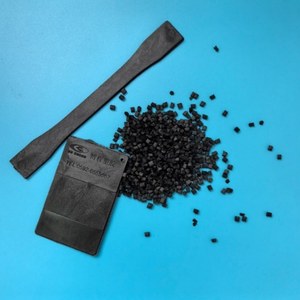
When a buyer writes "conductive, stiff, and moldable" into one line of a specification, the material list narrows fast. Nylon 66 with 40% carbon fiber — PA66 CF40 — sits at the top of that shortlist because it is one of the few injection-moldable thermoplastics that combines structural stiffness with genuine electrical conductivity. This guide works through what the 40% loading actually buys, where it stops paying, and how to qualify a supplier before the first production order.
The commercial backdrop supports the grade's momentum. The global Nylon 66 market was valued at USD 15.06 billion in 2023 and is projected to reach USD 23.64 billion by 2030, a 6.6% CAGR (figures as cited in the source), and the carbon-fiber-reinforced nylon segment is growing faster still at 8.5% CAGR through 2030, pulled by aerospace and automotive lightweighting. Asia-Pacific holds the largest regional share. CF40 is the premium slice of that growth: not the cheapest nylon, but the one that solves problems unfilled and glass-filled grades cannot.
What 40% carbon fiber actually changes
The "40%" is weight percentage of carbon fiber in the PA66 matrix, and the loading level is not arbitrary. Below roughly 20%, fibers do not form enough contact points for a continuous conductive network. Above 50%, processing becomes difficult and brittleness creeps in. The 40% configuration sits at the balance point where the fiber network is continuous, the compound still injection-molds and extrudes conventionally, and mechanical performance peaks.
The headline specifications cited in the source for the 40% grade:
| Property | Cited value |
|---|---|
| Tensile strength | 275 MPa |
| Elastic modulus | 26,800 MPa |
| Volume resistivity | 10⁻¹ Ω·cm (conductive range, as cited) |
| Continuous service temperature | 110°C |
| Short-term exposure | up to 200°C |
For context on the thermal figures, unfilled Nylon 66 tops out around an 80°C continuous limit in the source comparison — CF40 roughly raises the usable window by 30°C in continuous service, which matters for under-hood and machinery positions where unfilled nylon would creep or lose properties.
Choosing the carbon content: the fill-level ladder
More carbon is not monotonically better. The source's comparison across loadings gives buyers a clean decision ladder:
| Carbon content | Tensile strength | Conductivity | Processability | Best for |
|---|---|---|---|---|
| 15–20% | Moderate (180–200 MPa) | Semi-conductive | Excellent | Cost-sensitive general parts |
| 30% | High (230–250 MPa) | ESD-safe | Very good | Electronics housings, automotive interiors |
| 40% (CF40) | Maximum (275 MPa) | Conductive | Good | ESD-sensitive equipment, aerospace, industrial machinery |
| 50%+ | Slightly higher | Excellent | Difficult (brittle) | Specialized use only |
Two practical rules fall out of this table. First, if the requirement is static dissipation rather than true conductivity, 20–30% loading usually delivers it at lower cost and with kinder processing. Second, the jump from 30% to 40% buys the conductive network and maximum stiffness — pay for it only when the application genuinely needs one or both. Buyers weighing glass-filled alternatives should read our Nylon 66 GF60 high-stiffness guide: glass fiber raises stiffness and strength but leaves the part insulating, so it is not an ESD answer.
Where CF40 earns its premium
The source breaks demand down by application segment, and the pattern tells buyers where the grade is proven rather than theoretical: automotive 35.2% of demand, electronics 22%, aerospace 18%, industrial machinery 15%, and other uses 9.8%. Four duty profiles justify specifying CF40:
- ESD-sensitive environments. Electronics assembly, semiconductor handling, and facilities handling flammable materials need genuinely conductive parts, not merely static-dissipative ones. CF40's conductive network is the point of the grade.
- Maximum stiffness under load. Precision jigs, fixtures, and structural brackets where deflection must be minimized benefit from the 26,800 MPa modulus.
- Elevated temperature. Continuous service to 110°C with short-term exposure to 200°C suits under-hood and hot machinery positions.
- Weight-critical structures. Aerospace brackets and cable management where the strength-to-weight ratio outweighs material cost.
For electronics-adjacent ESD programs, our carbon-filled PPS ESD guide covers the higher-temperature alternative, and the ESD anti-static bags guide addresses the packaging side of the same requirement.
The honest limitations
CF40 is not a universal upgrade, and buyers who ignore its trade-offs discover them at the molding press:
- Impact resistance drops. Carbon fiber stiffens but embrittles. Parts subject to sudden shock or drop loads may need toughened nylon variants or lower carbon content.
- Viscosity rises. Higher filler loading makes thin-wall filling harder during injection molding; complex thin-wall geometries favor lower loadings.
- Machining gets harder. Carbon-filled stock is abrasive to cutters and finish — secondary operations argue for unfilled or lightly filled variants.
- Moisture discipline is mandatory. Practitioner feedback cited in the source describes drying regimens of 90–100°C for 8–12 hours and heated dry storage as near-essential for consistent properties. Hygroscopic nylon with 40% filler still absorbs water, and wet compound manifests as weak parts and surface defects. Our Nylon 612 low-moisture guide covers the lower-absorption family for humidity-critical programs.
Qualifying suppliers before the first order
Certification expectations segment cleanly by end market: IATF 16949 for automotive, UL recognition for electronics flammability positions, and AS9100 for aerospace. Because certifications attach to specific factories and products, buyers should verify scope directly with the issuing body rather than accepting a PDF at face value — the same factory-specific logic explained in our ISO 9001 plastic manufacturers guide.
Request a complete technical data sheet quoting tensile, flexural, volume resistivity, and thermal properties against recognized ASTM or ISO test methods; ask for drying and processing guidelines; and order samples for independent conductivity and mechanical verification before committing volume. Sample-first discipline is the cheapest insurance in a premium grade, and it dovetails with the process controls in our injection molding process guide.
Specification checklist
- Default to CF40 only when conductivity or maximum stiffness is a stated requirement — 20–30% carbon or glass-filled nylon covers most static-dissipation jobs at lower cost.
- Verify volume resistivity independently on sample parts, and confirm the test method and standard cited on the datasheet.
- Budget the thermal envelope correctly: 110°C continuous, 200°C short-term — not room-temperature properties.
- Plan drying and storage infrastructure (90–100°C, 8–12 hours; sealed, desiccated packaging) before the first production run.
- Match certification to end market: IATF 16949 automotive, UL electronics, AS9100 aerospace — verified with the issuing body, factory-specific.
- Screen for impact and thin-wall risk early: review part geometry for shock loading and wall thickness before locking the grade.
Related product categories
The materials and part types discussed above are grouped in our sourcing directory: