





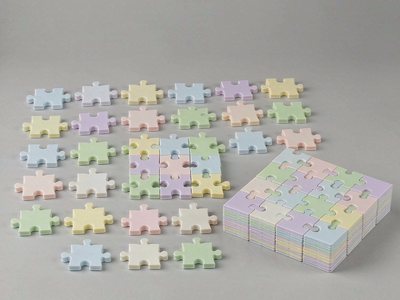

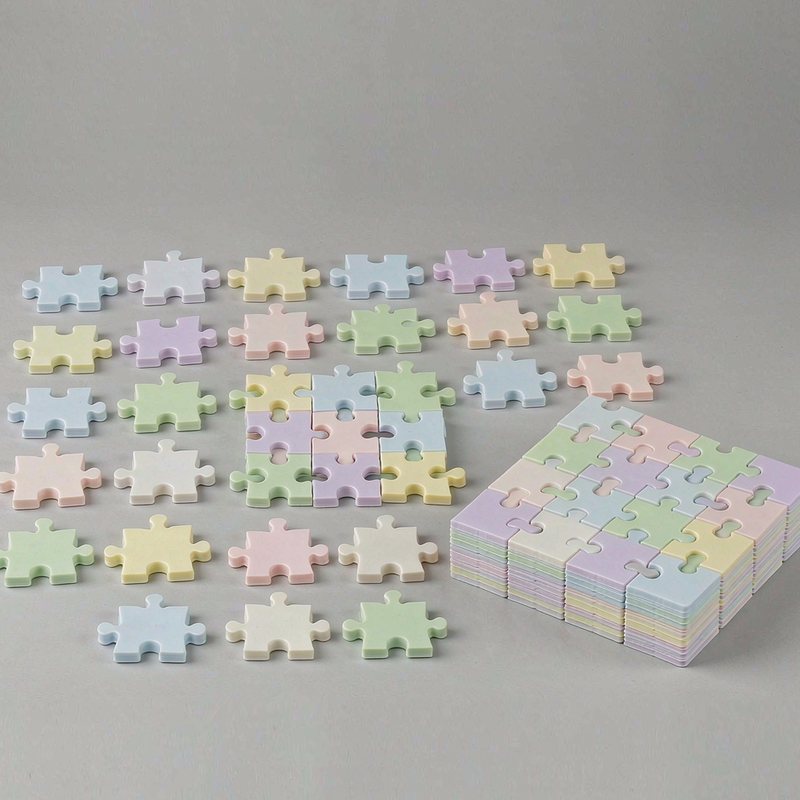

A jigsaw puzzle is judged by two things: whether the pieces interlock cleanly enough to hold together when lifted, and whether the cut lines fall where the picture can survive them. Both are set by the die, not by the printing, and a die that is a fraction out of register shows up on every single piece in the box.
We produce plastic and board jigsaw puzzles from 12 to 500 pieces, with cutting dies made in-house and print either laminated to a rigid sheet or applied directly.
Plastic sheet or laminated board
The two constructions behave differently and suit different buyers. A rigid PVC sheet gives a waterproof puzzle that survives a wet table and a wipe clean, which suits outdoor, bath and travel ranges. A laminated board is lighter, cheaper per unit and takes a wider range of print finishes, which suits gift and promotional work. Both are cut on the same style of steel rule die, but the PVC sheet needs a slightly larger clearance because it springs back after cutting.
Specification
| Material | Rigid PVC sheet 1.8 to 2.5 mm, or laminated grey board |
|---|---|
| Piece count | 12, 24, 35, 48, 100, 200, 300 and 500 |
| Finished size | A5 to A2, or a custom shape |
| CMYK offset or digital, matte or gloss varnish | |
| Cut | Steel rule die, standard or custom piece shapes |
| Packing | Shrink wrap, box with a printed lid, or a tin |
| MOQ | 1,000 sets per artwork |
Die cutting and interlock
A standard die uses a repeating grid of tabs and blanks, which keeps cost down and is entirely adequate for children's puzzles. A custom die can follow the artwork, so a puzzle of a map breaks along borders rather than through them. Custom dies cost more and take about 15 days to make, so they are usually reserved for runs above 5,000 sets or for a series that will be reprinted.
Interlock quality depends on the die clearance and the board thickness. Too tight and pieces tear at the neck; too loose and the puzzle will not hold together when lifted. We cut a test sheet from the production material before the die is approved, and check the fit on a sample of pieces from each corner of the sheet.
Artwork requirements
Artwork is supplied as a print-ready file at 300 dpi with bleed, and the cut line as a separate layer. Where the buyer has no cut line, we can generate a standard pattern. Photographic images need enough contrast in the mid-tones: a puzzle of a pale sky with a few pale clouds is technically printable and practically unsolvable.
Safety and age grading
Piece count sets the age grading. Puzzles under 50 pieces with small parts are graded 3 and above; larger piece counts are usually graded 6 and above. Edges are die cut and de-burred, and the ink system is checked for heavy metals where the destination market requires it. Where EN 71, ASTM F963 or CPSIA testing is required, samples go to a laboratory appointed by the buyer.