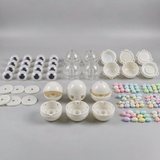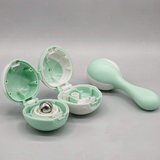







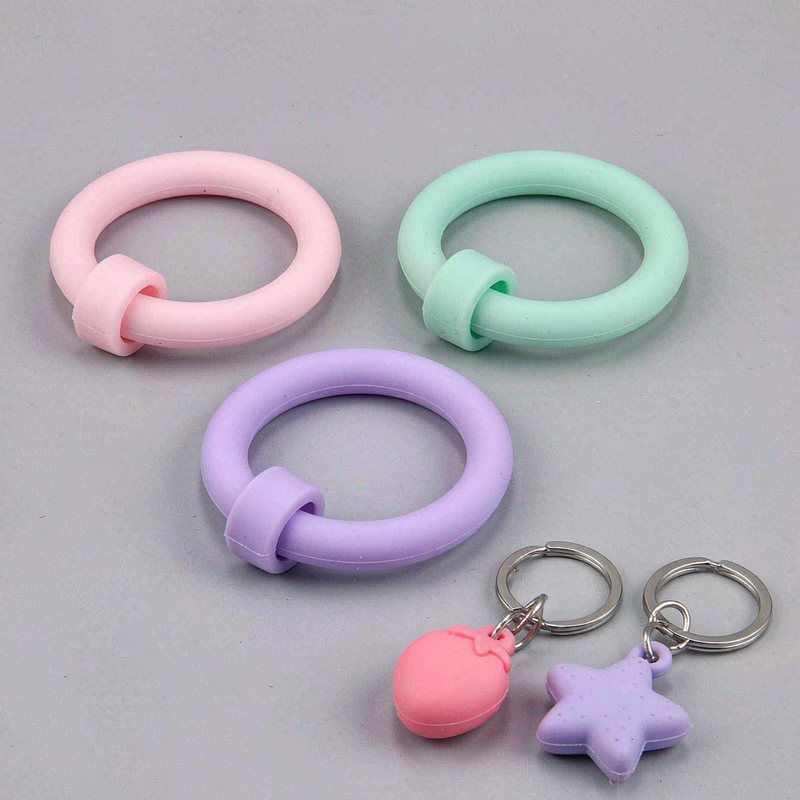

Fidget products split into two families that share a shelf and nothing else: soft squeeze toys moulded in TPR, and wearable silicone items — rings, bracelets and keychains — that are bought by adults and older children as desk accessories. The second family is a silicone programme: the material has to feel pleasant against skin, hold a Pantone colour exactly and survive keys in a pocket for a year. We run it as a separate line from our TPR squishy work because the resin, the tooling and the compliance documentation are all different.
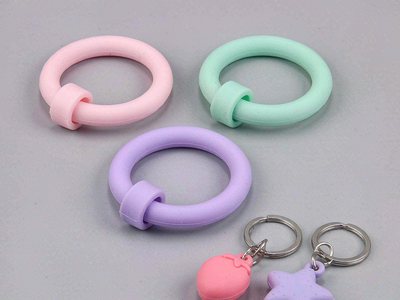
The programme covers fidget rings in band and bead styles, novelty keychains with insert-moulded hardware, and small charm shapes that ship as trading or vending items.
Why platinum-cure silicone
Fidget rings are worn, so the material touches skin for hours at a time. Platinum-cure (addition-cure) silicone is specified over peroxide-cure for this category because it carries no peroxide by-products, holds colour without yellowing and can be certified food-grade where the buyer wants that claim on the pack. Hardness is specified by Shore A and quoted per design: a ring band needs enough body to hold its shape on a finger, while a bead that spins inside the band needs a softer durometer so it moves without effort.
- Platinum-cure silicone, no peroxide by-products, food-grade option
- Shore A specified per component, band harder than moving bead
- Pantone matched with a lighted standard and delta-E reported
- Insert-moulded split rings and clasp hardware, pull tested per lot
Ring construction
A fidget ring is two components in one shot family: an outer band and an inner bead, moulded separately and assembled while uncured so the bead is captured without glue. The bead is specified to spin with a defined torque — loose enough to move with one hand, tight enough not to rattle — and the band is sized to a stated finger range rather than a single size, because a ring that only fits one finger generates size returns. Where the design adds a spinning outer track, the track runs on a moulded groove with the tolerance set in the tool.
Keychain and charm moulding
Novelty keychains are moulded around the hardware: the split ring or clasp is placed on carrier pins in the tool and the silicone is moulded over the anchor, so the joint fails at the silicone rather than at the interface. Charm shapes are moulded in multi-cavity tools with the hanging hole formed in-shot, and where a design calls for a two-tone finish, the second colour is applied as a separate shot on the same tool family rather than painted on.
Decoration and colour
Colour is the product in this category. Masterbatch is matched to the buyer's Pantone reference under a lighted standard, with delta-E reported on first articles so reorders match across seasons. Swirl and marble effects are produced by controlled multi-colour dosing rather than hand mixing, so no two pieces in a set are identical by accident. Where a design carries a printed face, the print is specified for flex durability, because a printed detail on a ring cracks within weeks.
Compliance
Silicone fidget items are produced to the standard the buyer nominates for their market, with the material declaration and migration testing supplied by the buyer's laboratory. We do not make medical or therapeutic claims for any item in this category; the products are specified and sold as novelty and desk accessories. Licensed characters are produced only against the buyer's written authorisation.
Specification
| Items | Fidget rings (band and bead), keychains, charms, spinners |
|---|---|
| Material | Platinum-cure silicone, Shore A 20 to 60 specified per part |
| Colour | Pantone matched under lighted standard, delta-E reported |
| Hardware | Insert-moulded split ring or clasp, pull tested per lot |
| Decoration | In-shot two-tone or swirl; flex-durable print option |
| Compliance | Buyer's nominated standard, material declaration per lot |
| MOQ | 2,000 pieces per design, 1,000 per colour within a design |
| Tooling | 25 to 35 days per item family |
Programme structure
Novelty programmes live on design count rather than piece count: a ring range of six designs at a low MOQ per design is the normal entry structure, and the tooling cost per design is small enough that a buyer can test a shelf of six before committing to a second wave. We quote per design with the colour range as a separate line, so the cost of adding a colour is visible before the order is placed.
For soft squeeze toys in TPR, see our squishy toy programme, or browse the Novelty & Squishy Toys category.