






Plush toys are sewn, not moulded, but every plush toy carries moulded parts: the squeaker that makes it sell, the safety eyes or embroidered inserts, the joint pellets that let an arm hold a pose, and the stiffening boards that keep a base flat. These parts are bought as components by sewing factories, and the buyer's problem is consistency across millions of units, not appearance on a shelf.
We mould plush toy plastic parts for sewing factories, brand licensees and toy assemblers: squeaker units, insert pellets, safety eyes, joint hardware and stiffening plates.
The squeaker is the whole job
A squeaker is a two-part moulding with an air chamber and a diaphragm, and the sound is set by the chamber volume and the diaphragm thickness. A squeaker that squeaks on the first squeeze and dies on the hundredth has a weld line in the chamber or a diaphragm moulded too thin. We mould squeakers in high-cavitation tools with the chamber dimension controlled to plus or minus five percent, and every lot is sound-tested on a sample basis rather than dimensionally inspected, because the sound is the specification.
Safety eyes versus embroidered
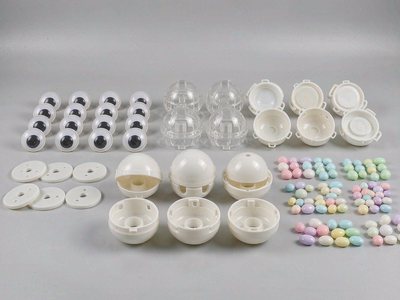
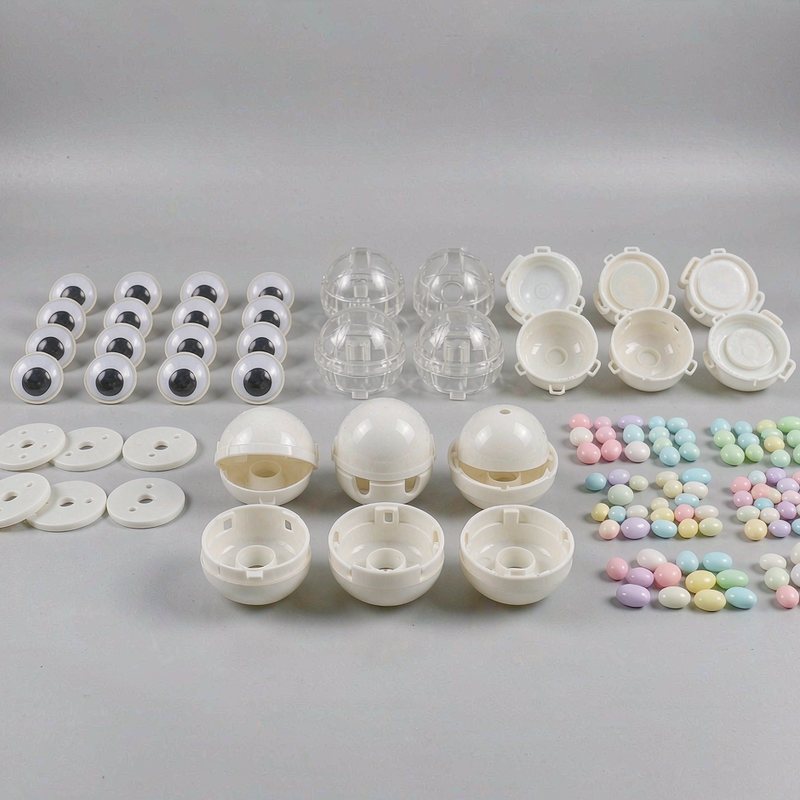
Moulded safety eyes with a retention washer are the lowest-cost option and the highest-liability one: the retention washer is the part that has to hold, and pull-testing is done on a sample basis per lot. For the 0-3 age grade, embroidered eyes carry no small parts at all and dominate the EU programmes, so those programmes buy no eye parts from us and buy the insert pellets and joint hardware instead. Where eyes are specified, we quote the pull force the programme requires and report the break mode, because an eye that pulls out clean is a tool problem.
Specification
| Squeaker | Two-part, chamber volume per programme |
|---|---|
| Insert pellets | PP, 6 to 20 mm, sand or HDPE fill |
| Safety eyes | ABS, washer retention, pull-tested per lot |
| Joint hardware | PP or ABS, snap or pin joint |
| Stiffening plate | PP or PS board, die-cut to pattern |
| Packing | Bulk bag with lot card |
| MOQ | 5,000 pieces per part number |
Insert pellets and weighting
Weighted plush toys use pellets, and the pellet choice decides the whole feel of the finished toy. PP pellets are the default; HDPE is firmer and quieter; glass microspheres give density without the rattle at a higher price. The moulding itself is straightforward, but the pellet has to be free of fines, because fines work out of the sewn seam and end up on the nursery floor. We screen every lot and declare the fines content.
Joint hardware for poseable plush
Poseable plush lines use moulded ball joints or pin joints inside the limbs, and the joint is moulded as two halves that snap around a fabric tab sewn into the limb. The design point is the snap retention versus the assembly force: a joint that assembles by hand without tools but holds against a child's pull. We cycle-test joints to the quoted count and report the retention after cycling, not just on the first article.
Compliance for plush components
Plush parts declare to EN 71-3 for the eight heavy metals and to the phthalate restrictions where PVC is used. The compound declaration covers the colourant system, which is where plush programmes most often fail, because the bright colours come from pigment loads that have to be declared individually. CPSIA programmes add a tracking label requirement that the sewing factory applies, so the parts we supply carry no label and the declaration pack names the lot for the factory's records.
Production and supply model
Plush components are a cavitation business: the price is set by how many parts come out of the tool per cycle, not by the press size. A squeaker tool at 16 cavities pays back quickly and locks the programme to a part number, which is why we ask programmes to fix the specification before the tool is cut. Lead time runs 20 days after approval for repeat lots, and tooling build runs four to six weeks. We supply against a rolling schedule rather than a single order, because a sewing line stops when a component runs out.
Related reading
Our finished plastic baby doll programme covers the moulded-plush boundary, and the dolls and plush category lists the full range.