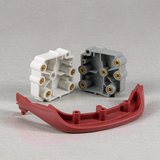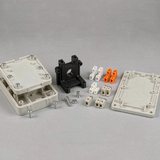






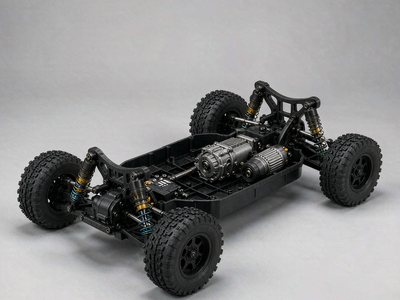

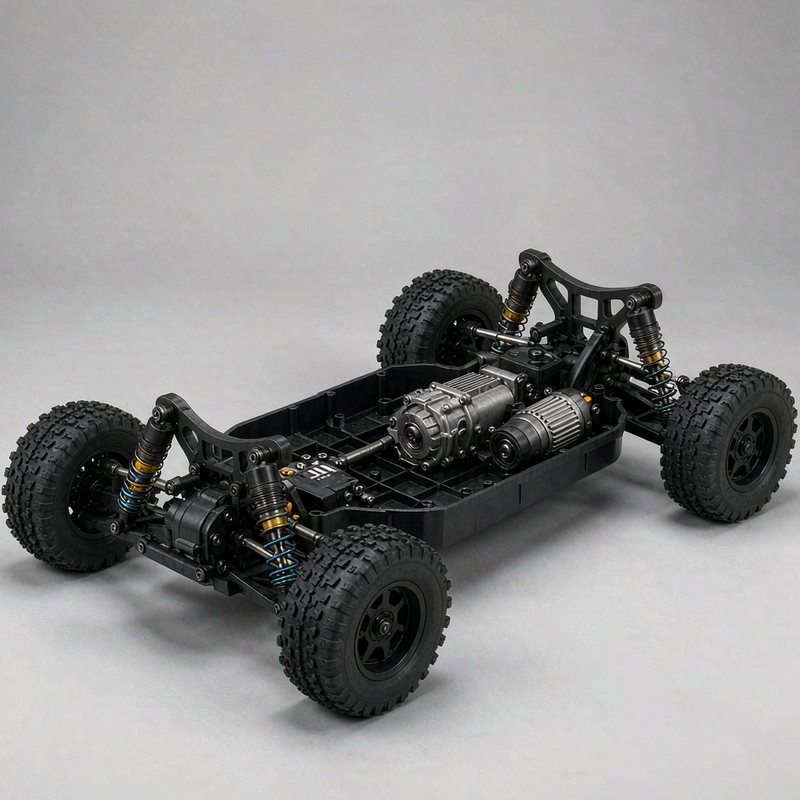

A radio control truck lives or dies on its chassis. The tub has to hold four suspension arms in alignment, keep the gearbox mesh stable under torque, and survive a landing that puts several times the vehicle weight through one corner. That is a different brief from a static toy car, and it changes both the material and the tooling.
We mould RC chassis sets in glass-filled nylon, with POM for gears and TPU for bumpers and skid plates.
The parts in a chassis set
- Main chassis tub, 2.5 to 3.5 mm wall, ribbed at the shock towers
- Gearbox halves with bearing seats and a slipper clutch pocket
- Lower suspension arms and hub carriers
- Shock towers, battery tray, motor mount and servo mount
- Bumpers and skid plates in TPU for impact absorption
Why glass-filled nylon
Unfilled PA is tough but flexible, and a chassis tub in it will bow under load and take the suspension geometry with it. Thirty percent glass fibre raises stiffness and creep resistance while keeping enough ductility to survive a hard landing without shattering. The trade-off is anisotropy: glass-filled parts are strongest in the flow direction, so gate position is chosen so that the main bending axis aligns with flow, not across it.
Specification
| Scale | 1:16 standard; 1:12 and 1:10 platforms available |
|---|---|
| Chassis material | PA6-GF30, black, UV stabilised |
| Gears | POM, module 0.5 to 1.0, machined or moulded |
| Bearing seats | ±0.05 mm, checked with pin gauges |
| Shock mounts | Metal insert or reinforced boss, pull tested |
| Finish | Matte moulded, optional pad print |
| MOQ | 500 sets per platform |
Assembly options
We can supply the chassis as loose moulded parts, as a partially assembled set with bearings and gears fitted, or as a complete rolling chassis with shocks, motor and servo installed. Partial assembly is the most common choice for brands that do final assembly and radio pairing closer to the market, because it reduces freight volume and lets the brand control the electronics.
Testing
Gearbox assemblies are run on a bench under load for a set number of cycles before approval. Chassis tubs are drop tested from a defined height onto a hard surface, and shock tower bosses are pull tested to the buyer's specification. Electronic components are sourced to the certification the buyer arranges for the destination market; battery packs ship under the applicable transport rules and are quoted separately.
Customisation
Wheelbase, track width, battery compartment size and body mounting posts can be adjusted within an existing tool family. A new platform, meaning new suspension geometry, needs new tooling, typically 40 to 50 days for a full set.