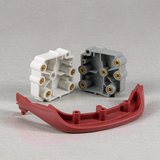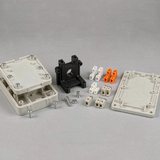






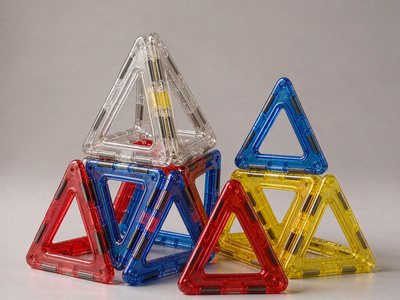

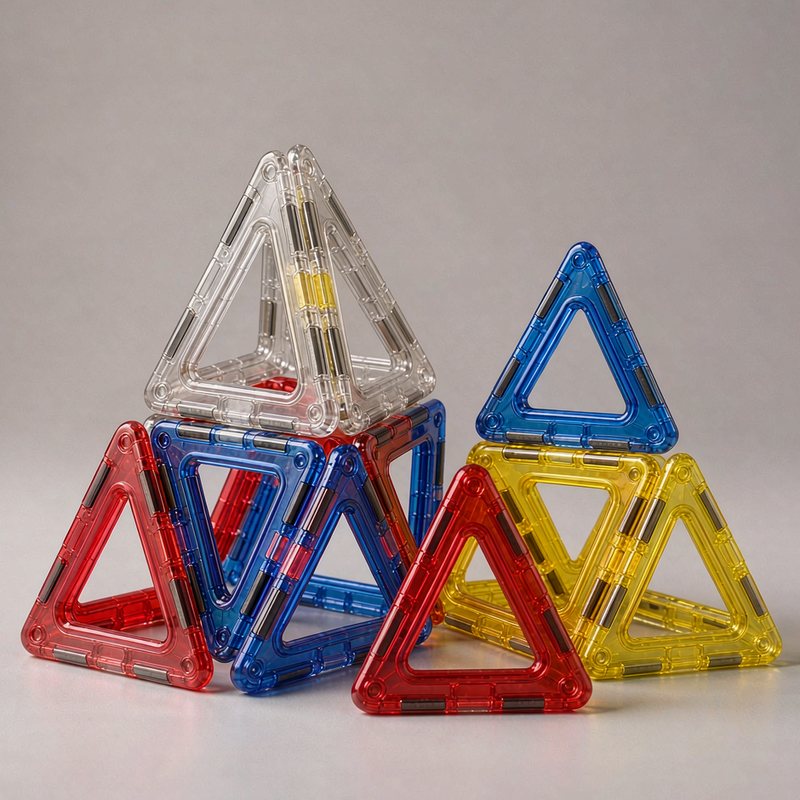

Magnetic tiles sell as a system, and the system is only as good as its weakest joint. A tile that clicks firmly at the factory and loosens after a month of classroom use is a warranty return, and the usual cause is the magnet joint rather than the magnet itself: the magnet cavity is too shallow, the edge wall too thin, or the magnet inserted after moulding instead of during. We mould the magnet into the frame, in the same shot, with the retention geometry designed around the magnet rather than around the tool.
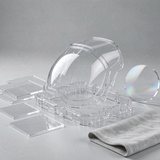
The programme covers the standard square, equilateral triangle and rectangle tiles in translucent colour, plus the window and wheel accessories that extend a set.
Insert moulding the magnets
Rare-earth magnets are placed on carrier pins in the tool and moulded in, so the magnet is encapsulated on five faces and retained by moulded ribs on the sixth. Retention is verified by a pull test on first articles and a torque test per production lot, with the acceptance values agreed before tooling. The alternative — gluing magnets after moulding — is cheaper on the tool and more expensive on the returns, because adhesive joints creep under the repeated peel loads a tile sees in play.
- Magnets encapsulated in-shot on five faces, rib retention on the sixth
- Pull and torque tests on first articles, torque re-tested per lot
- Magnet cavity specified so no plastic flash bridges the pole face
- Polarity mapped and marked on the tool so tiles attract face-to-face
Frame geometry and clarity
Frames are moulded in translucent ABS with the wall thickness held uniform, because a thick section next to a thin one shows as a flow line under light and reads as a defect on the shelf. Rivets and hinge features are moulded in the same tool as the frame, so a wheel accessory pivots on moulded bosses rather than a separate metal pin. Colour is masterbatch-matched and checked against a lighted standard, since the same resin reads differently under shop lighting and daylight.
Magnet safety
Tile sets are children's products, and magnet safety is treated as a design constraint rather than a paperwork step. The programme is produced to EN71-1 with the magnet retention and small-parts tests run on tiles in their as-shipped condition, and the buyer's nominated laboratory issues the report. Where a set is specified for younger children, the magnet size and count per tile are constrained to the standard the buyer nominates, and that constraint is designed into the cavity before steel is cut.
System tolerance
A tile system is a tolerance stack: tiles from different cavities have to build the same structure with the same click. Cavity-to-cavity variation is held by running the family from one tool with matched cooling, and the click force is specified as a range measured on a gauge. Where a set spans sizes, the geometry is dimensioned so any tile mates with any other without a gap that reads as a defect in a photographed build.
Specification
| Tile types | Square, equilateral triangle, rectangle, plus window and wheel accessories |
|---|---|
| Frame | Translucent ABS, uniform wall, masterbatch colour |
| Magnets | Rare-earth, insert moulded in-shot, pole faces kept flash-free |
| Retention | Pull test on first articles, torque test per production lot |
| Safety | EN71-1 magnet and small-parts tests as shipped, buyer's laboratory |
| Tolerance | Cavity-to-cavity matched by single tool and controlled cooling |
| MOQ | 3,000 pieces per tile type, full sets quoted as a programme |
| Tooling | 40 to 50 days per tile family with magnet carrier pins |
Set structure
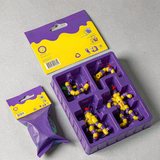
Tile programmes are quoted as a set structure rather than a piece price: one tool family per tile type, with sets assembled from a mix of squares, triangles and rectangles plus accessories. We quote the tool family once and the set bills of material separately, so a buyer can test one set size and extend to a range without re-cutting the frame steels.
For adjacent construction categories, see the Building Blocks & Model Kits page or our model kit sprue programme.