






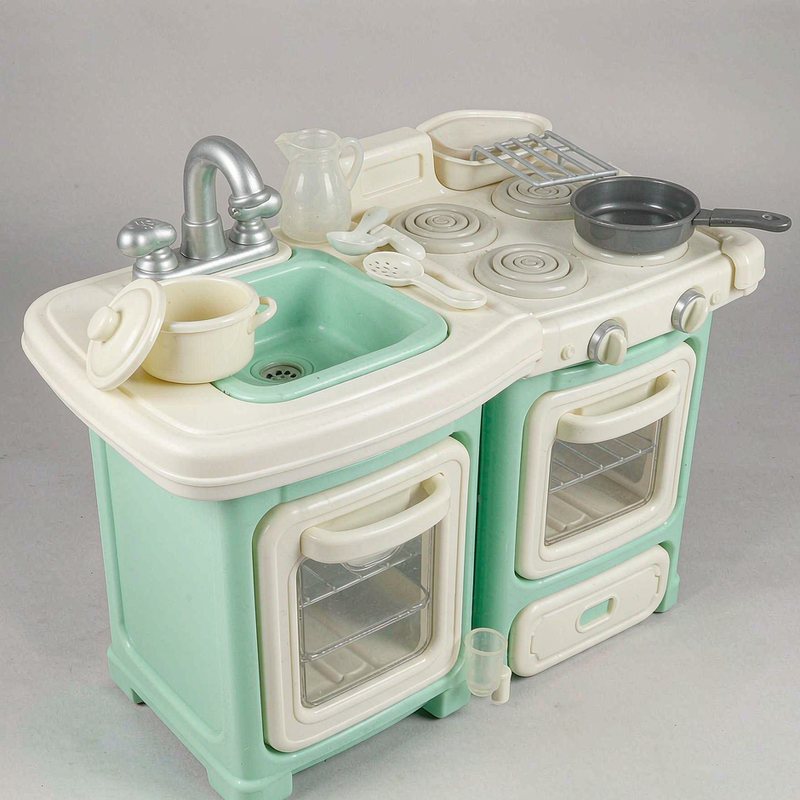

A play kitchen is one of the few preschool toys that has to look like furniture and survive like a toy. It gets leaned on, sat on, dragged across a floor and packed into a car boot. The moulded panels carry all of that, and the way the panels lock together decides whether the unit arrives at the customer's door square or rattling.
We mould compact pretend play kitchen units for toy brands, catalogue programmes and marketplace sellers, in PP for the large panels and ABS for the fittings and hinges.
What the set contains
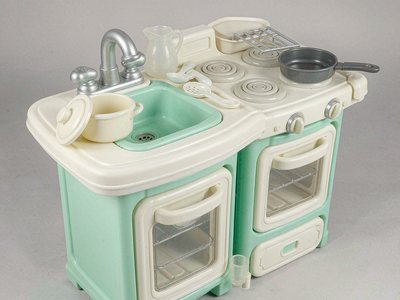
- Counter unit with moulded sink, tap body and two hob rings
- Oven compartment with a hinged door and chunky handle
- Side shelf and a set of hooks for hanging utensils
- Pot, pan, lid, two utensils and three play food pieces
- Knobs in TPR for grip, with a positive click stop
Panel design and assembly
The unit ships knocked down. Panels are joined with snap-fit tabs and a small number of screws, and each joint has a locating rib so that a customer cannot assemble it out of square. Wall thickness on the main panels sits at 2.8 to 3.2 mm: thick enough to resist a lean, thin enough to keep the carton weight sensible for parcel shipping.
Specification
| Assembled size | 62 x 30 x 78 cm |
|---|---|
| Body material | PP, colour matched to a Pantone reference |
| Fittings | ABS tap, hinges and brackets |
| Knobs | TPR overmould on PP core |
| Carton | Knocked down, 68 x 36 x 22 cm, 8.5 kg |
| Assembly time | Around 20 minutes with the illustrated sheet |
| MOQ | 300 sets per colourway |
Colour and finish
Panel colour is set by masterbatch at the moulding stage, so a colour change is a material change, not a paint change. That keeps the surface scratch-resistant, which matters because painted panels show every knock. Two-tone schemes with a cream body and a coloured counter are the most common configuration; we hold colour standards for repeat orders so a reorder matches the first shipment.
Safety and age grading
The set is graded for ages 3 and above. Edges are radiused, the oven door has a finger-safe gap, and no part is small enough to present a choking hazard after assembly. Where the set will be sold in a market that requires EN 71, ASTM F963 or CPSIA testing, samples are submitted to an accredited laboratory appointed by the buyer and production is held until the report is accepted.
OEM options
Colourway, decal artwork, carton print, instruction sheet language and the utensil assortment can all be changed without new tooling. Adding a fridge module, a sound chip or a moulded splashback requires a new tool and typically adds 25 to 30 days to the schedule.