





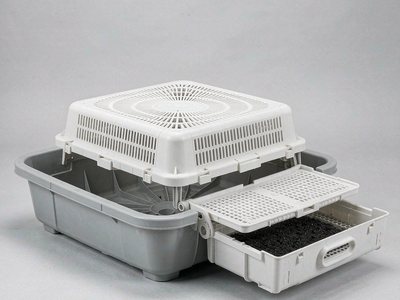

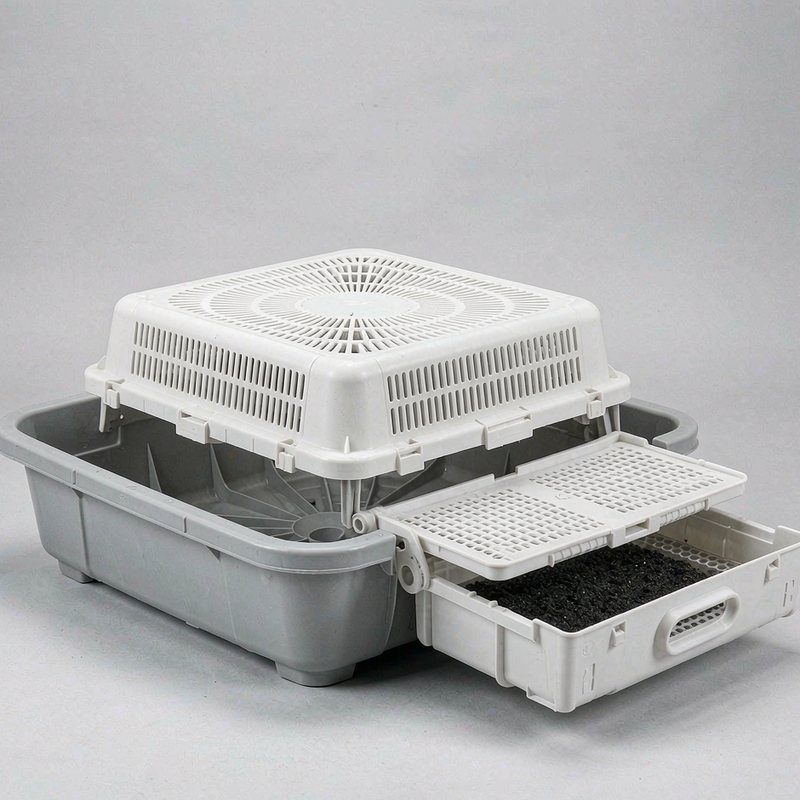

A litter box is a wide, shallow, largely flat part, which is the hardest shape to mould well. Pans that rock on a flat floor, hoods that close with a visible gap at the rim, filter trays that rattle: all three trace back to tool and flow decisions, not to the resin.
We mould cat litter boxes with vented hoods, carbon filter trays and sift panels for pet brands, supermarket programmes and e-commerce sellers.
Why flat pans warp
At 580 by 450 mm and 2.0 mm wall, the flow length is too long for a single edge gate. A pan gated from one edge short-shots at the far rim and, worse, cools unevenly and warps so it rocks on the shelf. The tool is gated from the centre or from two opposite edges with sequential filling, and the ejector layout is balanced so the part releases without bending. The base carries a slight crown and a rib pattern so the pan sits flat once cooled.
The hood and the vent
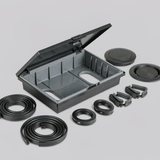
The hood is the second tool. It carries the vent slot array, which has to pass air and stop litter dust: a fine rib pattern cut in the hood top, with the slot width set to the dust size rather than to a drawing dimension. The filter tray is a third tool with its own snap features, and the tray usually decides whether the hood closes without a rim gap. Where the programme sells replacement filters, the tray is quoted with a low price and the hood tool carries the margin.
Specification
| Pan | 58x45x26 cm, crowned base, 2.0 mm wall |
|---|---|
| Hood | Vented slot array, removable filter tray |
| Sift panel | Optional, hinged with living hinge |
| Material | PP pan, ABS hood option |
| Filter | Replaceable carbon tray, refill programme |
| Packing | Nested stack or EVA-braced carton |
| MOQ | 500 pieces per colourway |
Hinges and latches
A hinged hood or a sift-panel latch adds a living hinge that will be cycled thousands of times. The hinge follows the PP rules: generous radius, polymer flowing across the hinge web rather than along it, and no weld line inside the hinge. We cycle-test hoods to the quoted count before the first production run, because a hinge that cracks at 300 cycles passes the first article and fails in the customer's hands.
UV and outdoor variants
Most litter boxes live indoors, but the covered-litter and outdoor-cat variants see sunlight, and unmodified PP chalks within a season. Those programmes are quoted with a UV-stabilised compound and a 1,500-hour QUV expectation, stated as a test target rather than a guarantee.
Packing for retail versus e-commerce
Retail shelf dimensions drive the outer carton more than the product design, so nesting depth is set by the planogram. E-commerce direct shipping is the harder case: an unbraced pan arrives cracked, so those programmes carry a corner-braced carton or a moulded EVA insert, and the freight quote has to include it.
QC on the first article
- Flatness of the cooled pan base on a surface plate
- Hood closure without a visible rim gap
- Filter tray fit and snap retention after 50 insertions
- Hinge cycle test to the quoted count
- Colour match under the buyer's light source
Tooling and lead time
Three tools carry the programme: pan, hood and filter tray. Build time runs six to eight weeks for the pan because of the conformal cooling, and four to five for the hood and tray, which can run in parallel. First articles are sampled in the production colour and measured after 24 hours of cooling, because a warm pan measures flat and a cold one does not. Production lead time is quoted at 30 days after sample approval, with nesting ratio agreed before the run so the freight quote matches the carton.
Related reading
Our gravity pet feeder programme covers the feeder interface, and the pet products category lists the full range.