







Garden furniture is moulded outdoors, in the sun, for years. A raised bed that chalks and goes brittle in the second season fails not because the PP was wrong but because the UV package was chosen on price. The second failure mode is warp: a 600 mm panel that bows after a hot week on a retailer's floor looks like a design fault and is a cooling problem in the tool.
We mould raised garden beds, compost bins and modular planters in UV-stabilised PP for garden retailers, DIY chains and outdoor brands.
Large-part moulding: the three decisions
- Flow. A 600 mm panel needs a sequential or fan gate from one long edge; a single point gate sinks the middle and starves the ends.
- Cooling. Panel tools are cooled with conformal circuits rather than drilled channels, because the warping comes from the temperature difference across the part, not from the average temperature.
- Ejection. A large panel sticks to the core and has to be released with air eject or a balanced pin layout; a part that bends during ejection is warped before it leaves the tool.
UV: what the additive actually buys
UV stabilisation in PP is a package, usually a hindered amine light stabiliser with a carbon black or pigment level tuned to it. The practical target for outdoor garden products is 1,500 hours of QUV without chalking or a significant drop in impact strength. Two cautions: pigment colour changes the effective UV life, so a light colour and a dark colour from the same compound are not equivalent; and a compound quoted to 1,500 hours should be tested in that colour, not in natural.
Specification
| Panel | 600x150x200 mm, modular joiner on both ends |
|---|---|
| Bed | 3 to 5 panels per tier, stackable tiers |
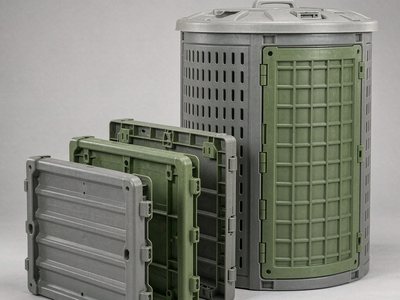
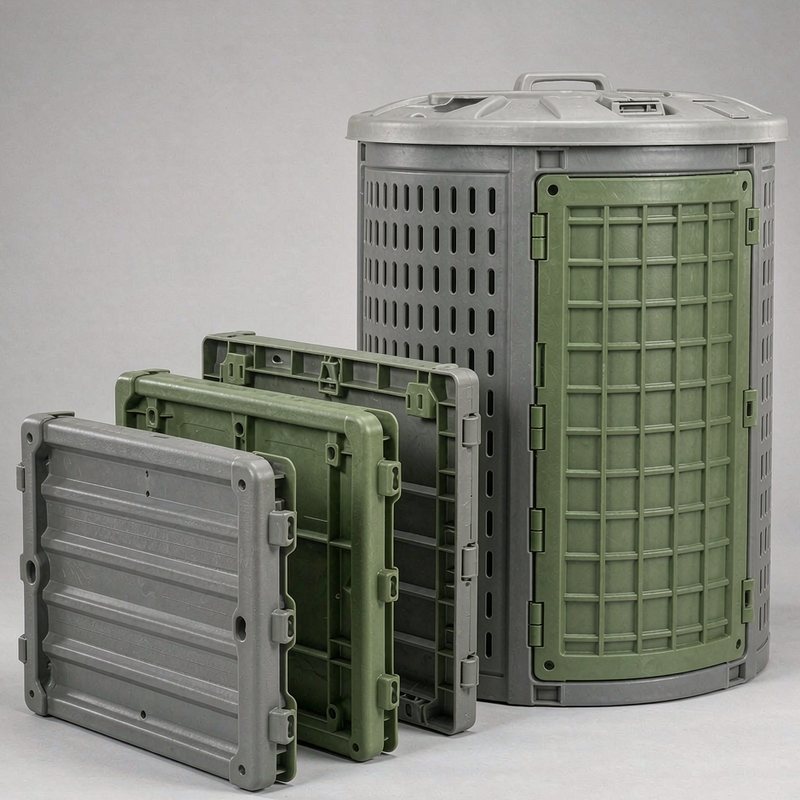
| Compost bin | 360 L, aeration slots, removable front panel |
| Material | UV-stabilised PP, recyclate content on request |
| Joiner | Snap-fit or screw, tool-free |
| Packing | Flat-packed panels, nested |
| MOQ | 200 sets per colourway |
Modular joiners
The joiner is what makes a bed a bed rather than four loose panels. A snap joiner has to hold against soil pressure, which for a 200 mm tier is modest, and against frost heave, which is not. The usual answer is a joiner that clips for assembly and is pinned with the same PP pin once in position, so the snap only has to survive the assembly and the pin carries the season.
Compost bin specifics
A compost bin is a garden bed with airflow. The aeration slots are cut in the panel tool, which means every new bin size is a new tool rather than a variant, and the slot pattern has to let air move without letting the pile dry at the walls. The removable front panel is the detail buyers ask for most, and it needs a latch that works with wet, compost-caked hands: a large ribbed pull rather than a small clip.
Packing and freight
Garden products ship flat or they ship as air. Nested panels at 8 to 12 per carton is the usual target, and it constrains the panel design: the nesting angle has to be moulded in, and the joiner cannot protrude past the panel face. Freight is quoted with the nesting ratio stated, because a design that nests six to a carton instead of ten doubles the landed cost at scale.
Tooling and lead time
A panel tool for a 600 mm part is a large tool to cut and to cool: build runs eight to ten weeks including the conformal cooling circuits, and the first article is measured after a full day of cooling. UV verification is a separate step, with test plaques moulded in the production colour and exposed to the quoted QUV hours before the programme is released for volume. Production lead time is 35 days after sample approval, and the tool is quoted separately from the part price so the two can be approved independently.
Related reading
Our plastic planter programme covers the smaller pot family, and the garden and outdoor category lists the full range.