









Most preform supply is natural PET in a narrow neck-finish family, and the market for that is a price conversation. The two families that are not are coloured preforms and wide-mouth jar blanks, and both are quoted on capability rather than on price: colour consistency across lots for the first, and a neck geometry that has to seal and stack for the second.
We mould coloured PET preforms and wide-mouth jar blanks for blowing programmes, packers and brand owners.
Coloured preforms: the colour is the specification
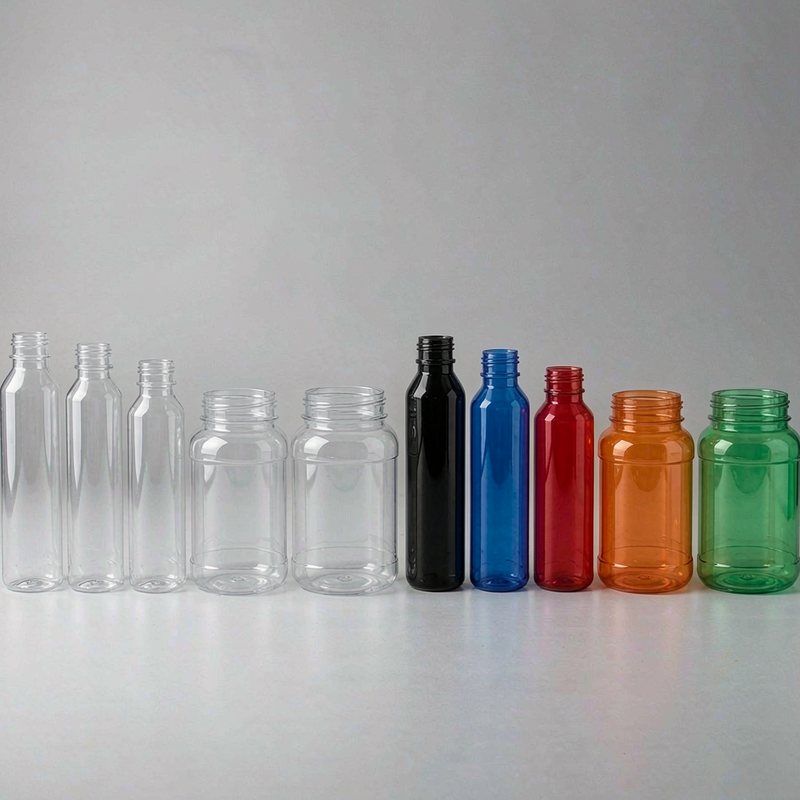
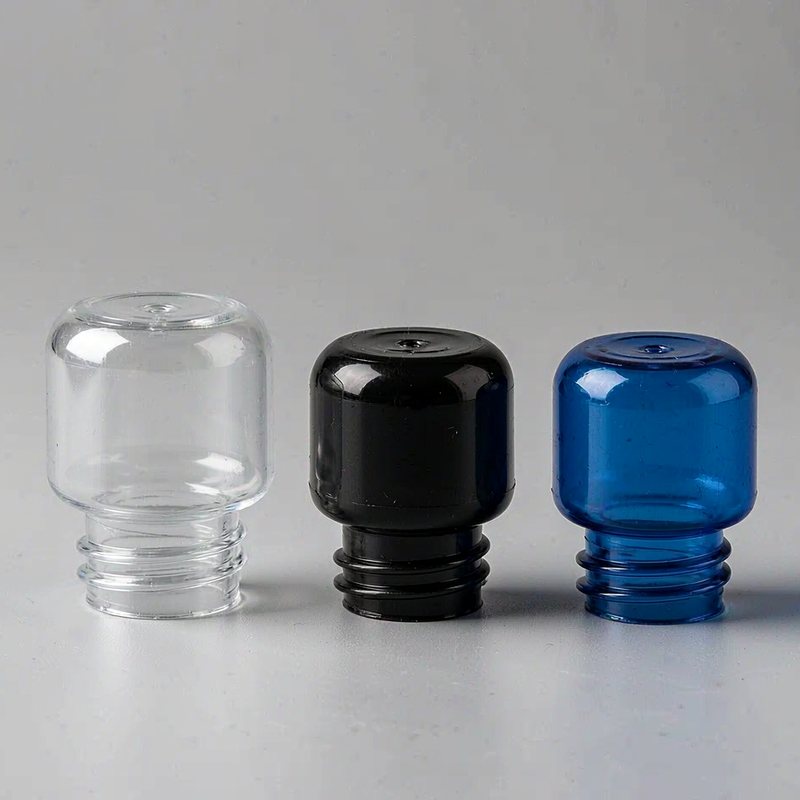
A coloured preform is blown into a coloured bottle, and the colour has to hold across the whole supply chain: lot to lot, cavity to cavity, and from preform to blown bottle. The colour is carried by masterbatch in the resin, and the practical control is a physical master held per programme with a delta-E target stated in the quality agreement. Two cautions we state on every quote: a colour change is also a compound change, so the food-contact declaration follows the colour, and a dark colour and a light colour from the same base resin do not carry the same IV after moulding, because the pigment load changes the thermal history the preform sees.
Wide-mouth jar blanks: geometry that seals and stacks
A jar blank is a preform for a container that is opened with fingers rather than a cap tool, which makes the neck a different problem. The finish has to accept a continuous-thread or a lug finish, the sealing surface has to be moulded free of sink at the thread runout, and the body has to stack in the blown state without deforming. The thread is moulded, not cut, so the tool carries the finish form and any tool change for a new finish is a new tool. We quote jar blanks against the closure the programme uses and sample the first article against that closure, because a thread that gauges correctly can still fail to run on a moulded closure.
Specification
| Bottle preform | 12 to 60 g, PCO 1881 and standard finishes |
|---|---|
| Jar blank | 63 to 110 mm finishes, continuous thread or lug |
| Colour | Masterbatch, delta-E per quality agreement |
| Weight tolerance | Plus or minus 0.2 g, verified per lot |
| IV range | Declared per programme, typically 0.76 to 0.84 dl/g |
| Resin | Food-grade PET, FDA and EU 10/2011 declarations |
| MOQ | 50,000 pieces per part number and colour |
Weight tolerance and the blowing window
The weight tolerance on a preform is not a dimensional nicety; it is the blowing window. A preform that is 0.5 g heavy blows into a bottle with a thin sidewall, and one that is light blows short. We hold plus or minus 0.2 g on the standard family and quote tighter where the programme's blow process needs it, with the weight verified per lot on a sampled basis and reported on the lot card. Where a programme runs its own blowing line, the lot card carries the weight distribution rather than only the average, because the line's reject rate follows the spread, not the mean.
Packing and handling
Preforms are supplied in tubes or bags with the neck finish protected, because a scored finish is a blown bottle that leaks at the sealing surface. Coloured preforms are packed per colour with a colour card attached to every carton, and mixed-colour programmes are packed with the lot number visible so the blowing line can trace a reject back to a preform lot. Jar blanks are packed in trays where the thread form needs protection in transit.
Compliance
PET preforms declare to FDA 21 CFR 177.1630 and EU 10/2011 as the destination requires, and the declaration covers the resin lot and the masterbatch separately. Where the blown container will hold a specific product class, the programme confirms the contact class before the preform is ordered, because the migration file follows the product class, not the container shape.
Related reading
Our PET preform programme covers the standard neck-finish family, and the preform category lists the full range.