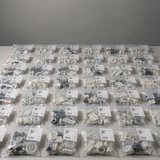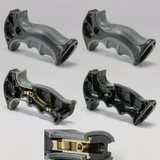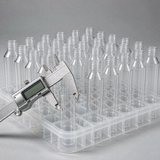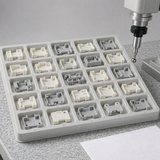







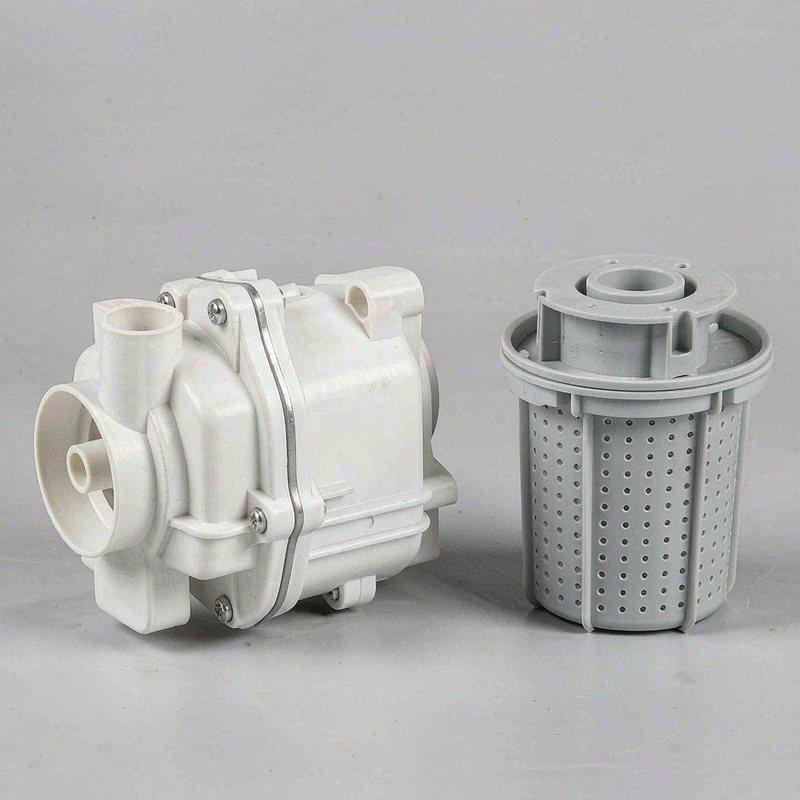

An ultrasonic weld is a sealed plastic joint made in a second, and it is specified by three things: the joint geometry, the energy delivered, and the cleanliness of the parts going in. A welded housing that leaks, or a basket that cracks at the weld after a season, almost always traces back to one of the three rather than to the welding machine.
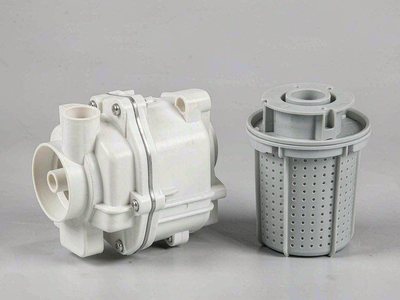
We weld pump housings and filter basket sub-assemblies for pump, appliance and filtration programmes, with joint design, flash control and per-lot leak testing.
Joint design
- Energy director. A small triangular ridge on one half that melts and fills the joint; the default for most thermoplastics and the easiest to mould.
- Shear joint. A interference fit that melts along the whole wall as the halves are pressed; used for hermetic seals and where the joint is large.
- Step joint. A lap joint that hides flash inside the part; used where the weld is visible in service.
Why ABS and PP weld differently
ABS transmits ultrasonic energy cleanly and welds with a modest energy director. PP is damping: it absorbs the vibration instead of transmitting it, so a PP weld needs higher amplitude, a far-field joint or a longer weld time, and it flashes more readily. Glass-filled PP welds stronger at the joint than unfilled, because the fibre carries the load across the melt, but the tool sees more wear. The joint design is quoted per material, not copied from a drawing that worked in ABS.
Flash control
Flash is molten plastic squeezed out of the joint, and it is controlled by three things: the energy director size, the weld depth (the distance the horn travels after contact), and the fixture that holds the halves square. A flash bead inside a sealed housing is not a cosmetic problem, it is debris in the fluid path, which is why housings that will carry liquid are welded with the joint designed to flash outward or into a capture groove.
Specification
| Part families | Pump housings, filter baskets, sealed enclosures |
|---|---|
| Materials | ABS, PP, PC/ABS, PA6, glass-filled option |
| Joint | Energy director, shear or step, per drawing |
| Leak test | Pressure decay per lot, reported |
| Weld strength | Pull or burst test per first article |
| Fixture | CNC aluminium nest, part-specific |
| MOQ | 5,000 pieces per assembly |
Cleanliness before the weld
Anything inside the halves at the moment of welding is sealed inside forever. Moulding flash, loose pellets, operator gloves and static dust all end up in the flow path of a pump or in the filtrate of a basket. Assemblies are welded in a cell where the halves are blown clean immediately before loading, and where the moulding line is in the same cell so the parts do not travel. Where the programme demands it, the halves are ionised before welding and the cell is inspected per shift.
Verification per lot
- Pressure decay: the assembly is pressurised and the decay measured over the stated interval
- Weld strength: pull or burst test on a sample, break mode reported
- Flash inspection at the joint line under magnification
- Fixture check: the nest is verified for wear each shift
Fixture design and cycle time
The fixture is the part of the weld cell that decides whether the joint is square. A nest that locates the halves on two datums holds the joint alignment through the weld; a nest that locates on one lets the halves shift as the horn descends and produces a joint that is strong on one side and open on the other. Cycle time runs 1 to 3 seconds per weld, so a cell with a rotary table weleds several assemblies per cycle and the labour content is the loading, not the welding.
Designing a part to be welded
Weldability is designed in, not added. The joint needs a flat land for the horn to contact, the wall at the joint must be thick enough to melt without burning through, and the part must not have a thin unsupported section near the joint that the weld energy will crack. Programmes that bring a sealed housing to quotation are reviewed for weldability before the tool is cut, because moving a rib after the tool exists is a tool change rather than a drawing change.
Related reading
Our moulded sub-assemblies programme covers the gearbox and latch family, and the sub-assemblies and inserts category lists the full range.