





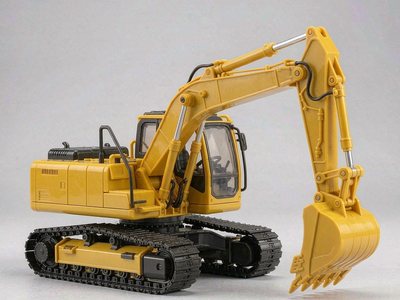

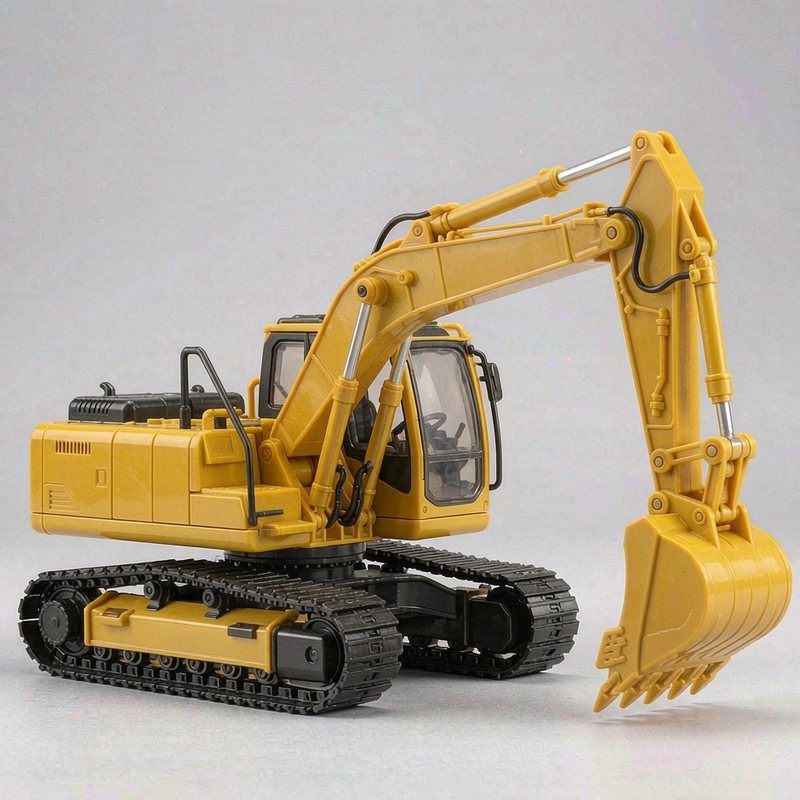

Construction vehicles are the most durable category in the toy vehicle aisle because children play with them as machines, not as characters: the arm has to dig, the bed has to tip and the drum has to turn. That makes them a plastics programme with a metals component, and the split between the two decides both the cost and the durability. We build them with a diecast chassis for weight and stability and moulded PP for the visible body and moving parts, which keeps the price where the category lives while surviving the sandbox.
The programme covers excavators, dump trucks, concrete mixers, bulldozers and cranes in 1:32 to 1:50, each articulated on moulded or metal pins.
Material split
The diecast chassis carries the weight that keeps the vehicle from tipping when the arm is extended, and it takes the drop impact that would crack a plastic base. The body, cab and arm are moulded in PP or ABS for detail and colour. The joint between the two is a screw or snap specification, not an afterthought: the mounting bosses are moulded into the diecast in the same tool family as the body clips, so the two halves locate before they fasten.
Articulation and pins
Every moving joint — boom, arm, bucket, bed, drum — runs on a pin specified for both retention and friction. Retention is the safety question: a pin that backs out under load releases a part a child can swallow, so pins are specified with a retaining feature, either a moulded collar or a swaged end, and the retention force is tested on a pull gauge per lot. Friction is the play question: a joint that flops under the weight of the part reads as broken, so the pin fit is specified by torque and adjusted in the tool rather than by assembly.
- Pins specified with positive retention, pull force tested per lot
- Joint friction set by pin fit and adjusted in the tool
- Diecast bosses moulded to locate body clips before fastening
- Moving parts cycle-tested on a rig before tool sign-off
Surface and print
Diecast parts are painted with a specified adhesion system, tested by tape and cross-hatch on first articles, because diecast paint that chips in the box is a retail rejection. Plastic parts are moulded in colour with tampo print for hazard stripes, window detail and small markings. Where a set includes a driver figure, the figure is moulded to the same scale and tested for the seat fit rather than glued into place.
Compliance and licensing
Vehicle programmes are produced to the safety standard the buyer nominates, with small-parts, tip-over and pin-retention tests run by the buyer's laboratory on first articles. We do not reproduce licensed vehicle brands, construction company liveries or protected characters; the programme runs on generic liveries and buyer-supplied original artwork only, and this is stated in the tooling agreement.
Specification
| Vehicles | Excavator, dump truck, mixer, bulldozer, crane; custom from tooling |
|---|---|
| Scale | 1:32, 1:40 and 1:50 platforms |
| Construction | Diecast chassis with moulded PP or ABS body and arms |
| Articulation | Boom, arm, bucket, bed or drum on retention-tested pins |
| Surface | Diecast paint adhesion tested by tape and cross-hatch |
| Safety | EN71-1/2/3, ASTM F963, pin pull force per lot |
| MOQ | 1,000 pieces per vehicle, 3,000 for a new platform |
| Tooling | 35 to 50 days for body, arm and diecast tool family |
Fleet economics
The diecast chassis tool is the fixed cost of the fleet; the bodies are amortised across the range. The efficient structure is one chassis family carrying three to five bodies, which is how a buyer builds a shelf set at three price points from one tooling package. We quote the chassis family and the bodies as separate lines so the fleet extension cost is visible before commitment.
For adjacent vehicle programmes, see our pull-back toy car programme or the Toy Vehicles category.