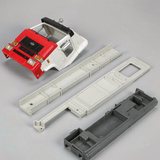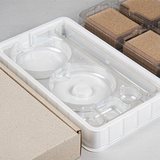







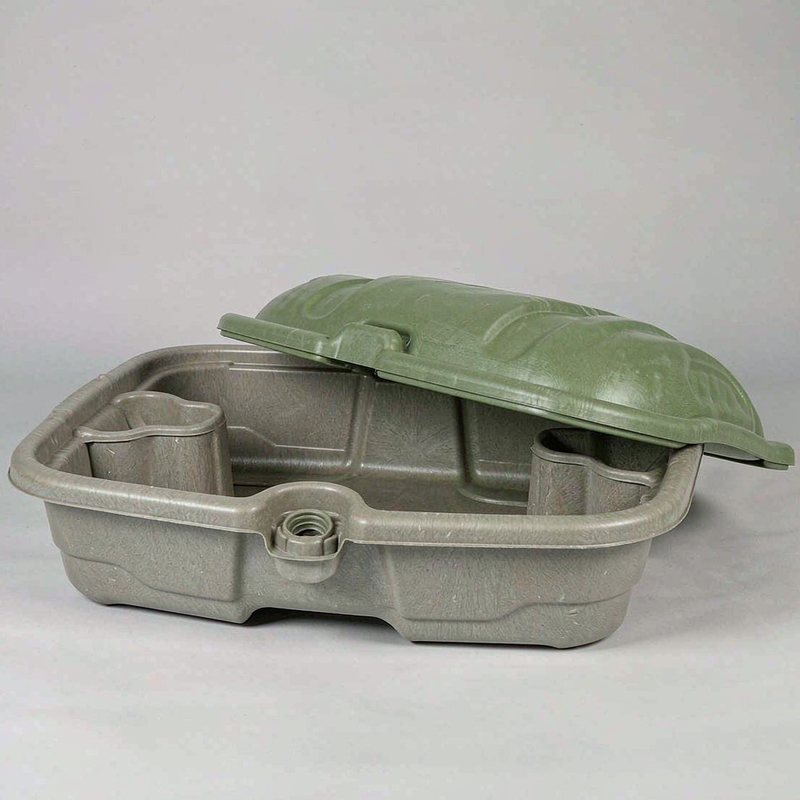

A sand and water table is a large, shallow, double-duty part that lives outdoors, holds water, drains, gets covered, and is dragged across a patio by a three-year-old. Four jobs, four failure modes: warp from the sun, leak at the drain, a lid that does not stay on, and a handle that comes off. Each is a moulding decision made before the tool is cut.
We mould sand and water play tables for garden retailers, campgrounds, nurseries and outdoor toy programmes, with lids, drains and accessory mouldings as part of the programme.
Basin moulding: flat, shallow, and unwarpable
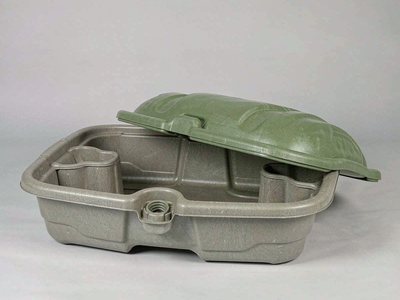
The basin is the hard part: a 600 by 400 mm shell at 2.2 mm wall with a 30 mm depth. Flow length rules out a single gate, so the tool is gated sequentially along one long edge with the flow front managed by valve gates, and cooled with conformal circuits, because the warp comes from the temperature gradient across the part rather than the average. The base is crowned slightly so the filled table sits flat rather than rocking on three feet.
The drain is the warranty
Every water table drains, and every drain is a leak waiting for a tool change. The drain plug is moulded as a separate part with its own gasket, and the gasket groove is cut in the basin tool with the compression set by the plug design rather than by hand pressure. We leak-test first articles by filling and standing the table for 24 hours, and we quote the plug as a spare part, because the plug is the part that gets lost down the drain in the first season.
Specification
| Basin | 600x400 mm, 2.2 mm wall, crowned base |
|---|---|
| Capacity | 20 to 40 L depending on depth |
| Drain | Moulded plug with gasket groove |
| Lid | Optional, snap or hinge, sand or water duty |
| Material | UV-stabilised PP copolymer |
| Handles | Insert-moulded or through-bolted |
| MOQ | 200 tables per colourway |
Lids: two materials, one tool family
A lid does two incompatible jobs: it keeps rain out of the sand and it becomes a play surface when the table is in water mode. A flat lid does neither well, so the usual design is a slightly domed lid with a drainage fall, moulded in the same UV PP as the basin and snapped with features that survive a year of UV. Where the programme sells the lid as an accessory, it is quoted separately with its own colourway, because a lid is the most colour-sensitive part on the table.
UV: the additive is the product
A play table sees more sun than almost any other toy, and unmodified PP chalks and embrittles within a season. The UV package is a hindered amine stabiliser tuned to the pigment, and the practical target is 1,500 hours of QUV without chalking or a significant drop in impact. Two cautions we state on every quote: a light colour and a dark colour from the same compound are not equivalent, and the verification has to be run in the production colour, not in natural.
Handles and the drag load
The handle is what a child actually uses: the table gets dragged across a patio full of sand and water, and the load at the handle is the weight of the contents. A handle insert-moulded into the basin wall holds only if the wall behind it is thick enough to carry the load, so the handle bosses are backed by ribs that run down into the base. We load-test handles to the filled weight of the table plus a margin and report the failure mode, because a handle that tears out of the wall is a rib problem, not a handle problem.
Tooling and lead time
The programme is three tools: basin, lid and drain plug, with the basin at eight to ten weeks because of the conformal cooling. Accessory mouldings such as funnels, ramps and boats run in parallel on smaller tools. Production lead time is 30 days after approval, and the tool is quoted separately so the programme can approve the part price and the tool independently. Freight is quoted with the nesting ratio for the lids stated, because a lid that nests badly doubles the landed cost.
Related reading
Our water blaster programme covers the smaller water toy family, and the outdoor toy category lists the full range.