




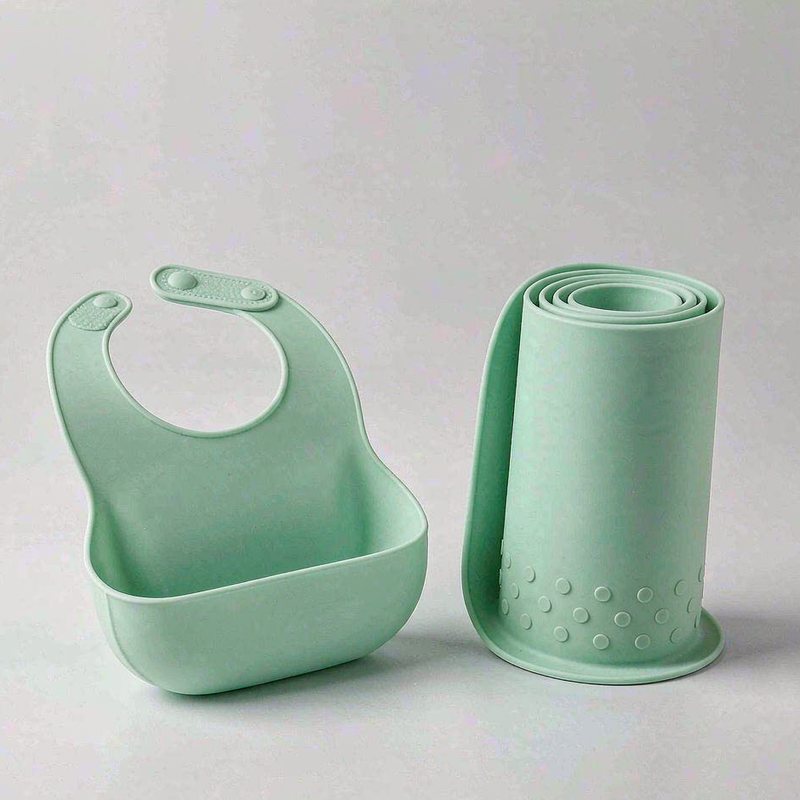

A silicone bib fails in two ways. It stains on the first week of pureed carrot and looks used by the first month, or it loses its softness after repeated sterilising and ends up stiff enough to irritate the neck. Both are material decisions, and both are made before the tool is cut.
We mould baby bibs and placemats in platinum-cured silicone for baby care brands, nursery chains and private-label sellers, from cold-runner LSR tools in a clean-room cell.
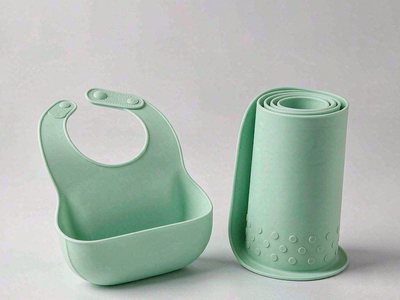
What the set contains
- Bib with a deep crumb-catching pocket and an adjustable neck fastening
- Roll-up placemat with a raised rim and suction dots on the base
- Optional matching spoon with a soft tip
- Colour box or printed set bag as the market requires
Why platinum silicone rather than TPE or PP
TPE bibs are cheaper and sterilise acceptably, but they carry plasticiser, and the plasticiser is what stains and what stiffens after heat. Platinum-cured silicone carries no plasticiser, survives both dishwasher and steam steriliser at 230 C, and stays soft through hundreds of cycles. For a product that lives on a high chair and is washed daily, that difference decides the return rate.
Tooling notes
An LSR bib tool is a cold-runner tool with the manifold cut to fill a wide, shallow cavity without weld lines at the pocket seam. The pocket depth is the design point: a pocket deeper than 25 mm catches food but folds when the bib is rolled, so the profile is usually a tapered pocket that rolls flat. The placemat is the simpler part, but the suction dots are demoulded from the cavity side and need a texture chosen for release rather than gloss.
Specification
| Bib | 45x28 cm, tapered pocket, adjustable fastening |
|---|---|
| Placemat | 40x30 cm, raised rim, suction dots, rolls up |
| Material | Platinum silicone, BPA free, no plasticiser |
| Temperature | -40 to 230 C, dishwasher and steam safe |
| Decoration | Moulded-in colour, laser etch or printed insert |
| Packing | Colour box with care card |
| MOQ | 2,000 sets per colourway |
Food contact compliance
Silicone compounds are declared to FDA 21 CFR 177.2600 or EU 10/2011 and LFGB as the destination requires, with volatile content and peroxide residue results included where the cure system calls for it. Migration testing of the finished bib is commissioned by the buyer at an accredited laboratory; we supply the compound declaration and the plant declaration, not a certificate in a third party's name.
Decoration that survives washing
Silicone cannot be pad printed without a primer, and a primed print eventually lifts at the edges after dishwasher cycles. The durable routes are moulded-in colour, laser etching for line detail, or a printed insert captured between two silicone layers in a second shot. Where a brand needs a full-colour illustration, the captured-insert route holds the artwork longest and costs one extra tool.
Market notes
EU programmes ship with a multilingual care card and, increasingly, a QR code to a digital manual. US retail buyers ask for a chocking-hazard assessment on any fastening smaller than the regulated threshold, which for bibs usually means moving to a sewn-in or snap fastening rather than a loose tie.
Production and handling
Bibs and placemats are moulded in a dedicated clean-room cell, because a silicone part that will touch a baby's clothes carries the same handling expectations as food contact production. Each batch is traceable to the compound lot and the press, and the packing is done in the same cell rather than moved to a general line. Tooling build for a two-part set runs four to six weeks, and first articles are sampled in the production colour rather than natural so the decoration route is proven before the run.
Related reading
Our food grade PP feeding set programme covers the rigid half of this category, and the baby and maternity category lists the full range.