







Two silicone parts can share a drawing and a colour and still be different products. A component at Shore A 10 collapses under its own weight when demoulded; the same component at Shore A 40 holds shape but feels clinical in the hand. Hardness is the specification most often left blank on wellness drawings, and it is the one that decides whether the part performs.
We mould body-safe silicone components across the Shore A 10 to 40 range for personal care, wellness and fitness brands, with biocompatibility declarations and compound lot traceability as standard.
Choosing the hardness
- Shore A 10-15. Ultra-soft skin-contact parts; needs a rigid core or a thick section to demould without distortion.
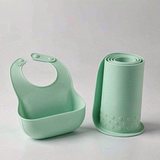
- Shore A 20-30. The comfort band for handheld parts; compresses under grip without bottoming out.
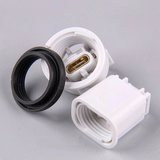
- Shore A 30-40. Functional parts: rings, beads, seals and caps that must hold dimension and snap.
Why the soft grades are harder to mould
Soft compounds have low green strength, which is the strength of the part while it is still warm. A Shore A 10 part that demoulds perfectly at 30 seconds tears when the robot pulls it at 25. The press programme for soft grades runs slower, the ejector pins are larger and fewer, and the part is often demoulded onto a shaped foam nest rather than onto a belt. Where a programme needs both soft and firm parts, they are quoted as separate tools rather than as one tool with a compound swap, because the cycle and the demoulding are genuinely different processes.
Biocompatibility: what is declared and by whom
Body-safe claims rest on ISO 10993 testing of the finished device, which the buyer commissions at an accredited laboratory. What the moulder supplies is the compound declaration: base polymer, cure system, pigments and any additives, with a statement that the compound is platinum-cured and peroxide-free, plus the plant declaration confirming the production line. We declare our compounds against ISO 10993-5 (cytotoxicity) and ISO 10993-10 (irritation and sensitisation) on the material level, and we say so plainly, because presenting a third-party device certificate as our own would be misleading.
Specification
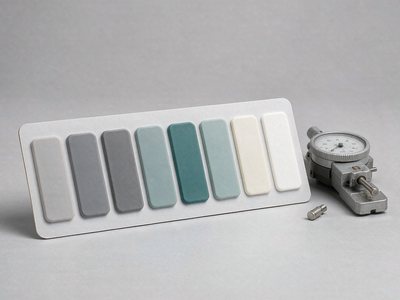
| Hardness | Shore A 10 to 40, measured to ASTM D2240 |
|---|---|
| Compound | Platinum-cured LSR, no plasticiser, no peroxide residue declared |
| Biocompatibility | ISO 10993-5 / -10 compound declaration, device testing by buyer |
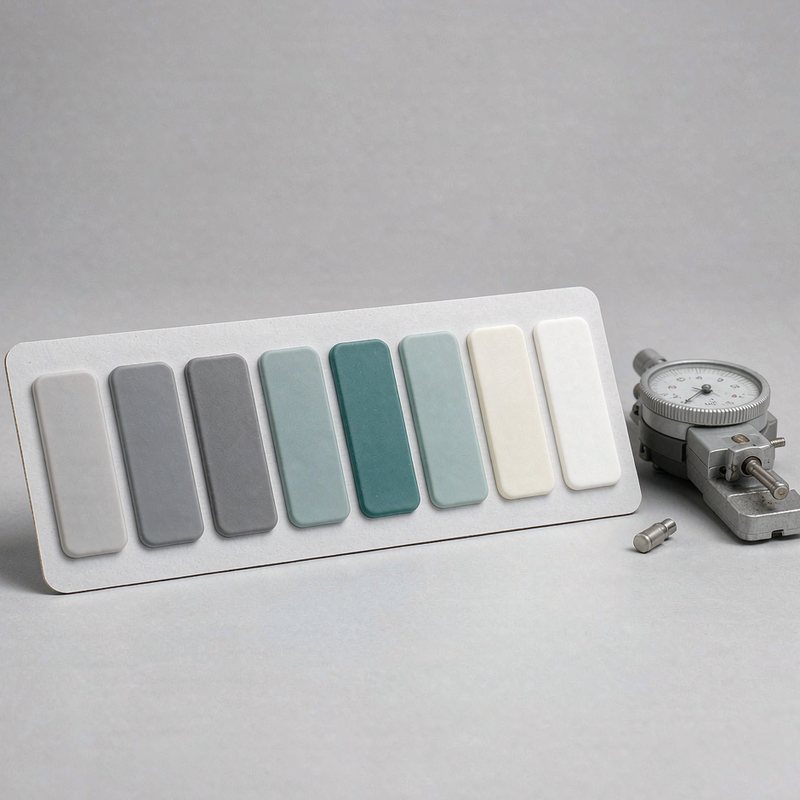
| Colour | Moulded-in, Pantone or RS card matched |
| Traceability | Compound lot and press recorded per batch |
| Packing | Bulk bag, header card or insert tray |
| MOQ | 3,000 pieces per hardness and colourway |
Compression set and why it matters
A silicone part that is compressed in storage arrives flat. Compression set is the permanent deformation left after a defined load and time, and it varies with compound, cure and post-cure. Soft, high-filler compounds set more than firm ones. Parts that ship nested inside each other are post-cured and cooled flat before packing, and programmes with tight dimensional claims are quoted with a post-cure step in the cycle rather than as an afterthought.
Colour matching and colour drift
Moulded-in colour is matched against a Pantone or RAL card under the buyer's light source, with a delta-E tolerance quoted rather than assumed. The drift risk in silicone is not the pigment batch, it is the cure: a part that under-cures shifts colour slightly and loses compression set performance at the same time. That is why cure verification is part of the colour sign-off rather than a separate QC step.
Tooling notes
LSR tools for this hardness band are cold-runner tools with the manifold sized for the soft grades, which fill fast and trap air if the venting is designed for firm compounds. The vent depth is cut to the thinnest section the tool will ever run, so a firm part does not flash when the same family runs soft. Cavitation for accessory parts is typically 8 to 16, because at these part sizes the cycle time is dominated by handling rather than by cure.
Related reading
Our platinum silicone LSR molding programme covers the tooling side of this category, and the silicone intimate products category lists the full range.