Why carbon-filled PPS occupies a unique slot
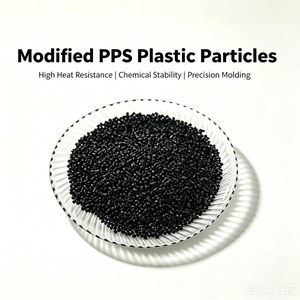
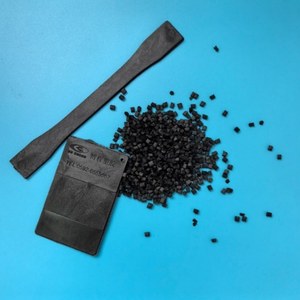
Polyphenylene sulfide (PPS) is already a high-performance engineering plastic: intrinsically flame retardant, chemically resistant, and stable at temperatures where nylons and polyesters have long since softened. What plain PPS cannot do is dissipate static charge — and in electronics assembly, semiconductor handling and EV battery compartments, an insulating part is a defect waiting to happen. Filling PPS with 20-30% carbon fiber by weight solves both problems at once: it turns the resin electrically dissipative while raising mechanical strength, and it does so without sacrificing the thermal performance that made PPS attractive in the first place.
The market backdrop supports taking the specification seriously. The global PPS market is valued at USD 2.01 billion in 2026, projected to reach USD 3.99 billion by 2034, an 8.95% CAGR (Fortune Business Insights, as cited by the source). Demand is concentrated in exactly the sectors that need ESD control: automotive accounts for 40% of PPS consumption (intake manifolds, sensor housings, EV battery components), followed by electrical and electronics at 25% (connectors, coil bobbins, semiconductor carriers), industrial at 18% (pump parts, valve components, filtration media) and aerospace at 10% (cable insulation, interior components, ducting).
The numbers that define the grade
| Property | Typical value | Test standard | Why buyers care |
|---|---|---|---|
| Carbon fiber content | 20-30% by weight | ISO 10350 | Determines conductivity and mechanical strength |
| Surface resistivity | 10²-10⁵ ohms | ASTM D257 | ESD-safe range for electronics handling |
| Continuous service temperature | 220-240°C | — | Survives reflow and under-hood environments |
| Melting point | 278-280°C | — | Processing window for injection molding |
| HDT | 255-280°C @ 1.82 MPa | — | Dimensional stability under load at temperature |
| Density | 1.41-1.58 g/cm³ | — | Cross-check against filler level claims |
The temperature advantage is the differentiator against other ESD-capable plastics. Carbon-filled PPS maintains over 90% of room-temperature tensile strength at 150°C, compared to roughly 60-70% for glass-filled nylon and 50-60% for unfilled PBT. For a semiconductor carrier or an EV battery component that runs warm, that gap is the difference between a qualified part and a field failure.
Reading the ESD specification correctly
Not everything that conducts is ESD-safe, and the distinction appears on datasheets as a resistivity class:
- Conductive: below 10³ ohms — suitable where active charge drainage is required, but can create hard-discharge risks in some handling contexts.
- ESD-safe / dissipative: 10³-10⁹ ohms — the target band for electronics handling; carbon-filled PPS at 10²-10⁵ ohms sits in the conductive-to-dissipative transition, draining charge fast without the risks of a fully conductive surface.
- Insulating: above 10⁹ ohms — unfilled or mineral-filled PPS; acceptable for structural parts, disqualifying for ESD-controlled environments.
Two certification frameworks matter when buyers audit suppliers: ANSI/ESD S20.20 and IEC 61340-5-1. Test reports against these standards — plus the ASTM D257 surface resistivity method — are the documentation that separates a verified dissipative grade from a marketing claim. Batch-to-batch resistivity variation is a fair question to put to every supplier, because carbon dispersion is exactly the kind of process variable that drifts between lots.
The fiber-loading tradeoff
Within the carbon-filled family, higher fiber loading (30% vs 20%) generally improves HDT and creep resistance but may reduce impact strength. That tradeoff maps directly onto application choice: high-load, dimensionally critical parts (connector housings, pump components) justify 30% loading, while parts that see drops or assembly impact are safer at 20-25%. Where ESD protection is not required, the source notes that mineral-filled or glass-filled PPS variants may offer sufficient mechanical performance at lower cost — the carbon premium should be paid only when the dissipative function is actually needed. For industrial OEMs with chemical exposure, 20-25% carbon-filled with PTFE lubrication is the configuration the source points to for combining chemical resistance, wear performance and ESD function.
Procurement checklist for carbon-filled PPS
- Confirm the ESD class you actually need — dissipative (10³-10⁹ ohms) for most electronics handling; conductive only where the application demands active drainage.
- Demand ASTM D257 surface resistivity data with the loading level — 20% and 30% compounds are different materials with different prices.
- Check the thermal envelope against your process — 220-240°C continuous and 255-280°C HDT cover reflow and under-hood duty; unfilled PBT and glass-filled nylon do not.
- Ask for creep data at 150°C — the >90% strength-retention claim is only useful if the supplier can show it for the specific compound.
- Verify certification scope — ANSI/ESD S20.20 or IEC 61340-5-1 test reports, plus batch-to-batch resistivity variation history.
- Qualify the end market — automotive programs expect IATF 16949 system coverage; confirm whether the supplier holds it before scheduling audits.
Bottom line for 2026 sourcing
Carbon-filled PPS is the intersection material: ESD function for the electronics and EV sectors driving 65% of PPS demand (automotive 40% + electrical/electronics 25%), with a thermal envelope no nylon or PBT alternative can match. Specify the resistivity band and fiber loading first, then let HDT and creep data settle the 20% vs 30% question — and keep mineral or glass-filled grades on the shortlist for any part where static dissipation is not a requirement.
Figures in this guide are compiled from the cited source for procurement reference. Market sizes, growth rates and specification ranges reflect the source's research scenario and vary by region, grade and manufacturer; verify current datasheets, test conditions and certifications directly with material suppliers. This article does not constitute engineering, legal or investment advice.
Related product categories
The materials and part types discussed above are grouped in our sourcing directory: