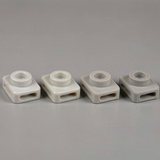






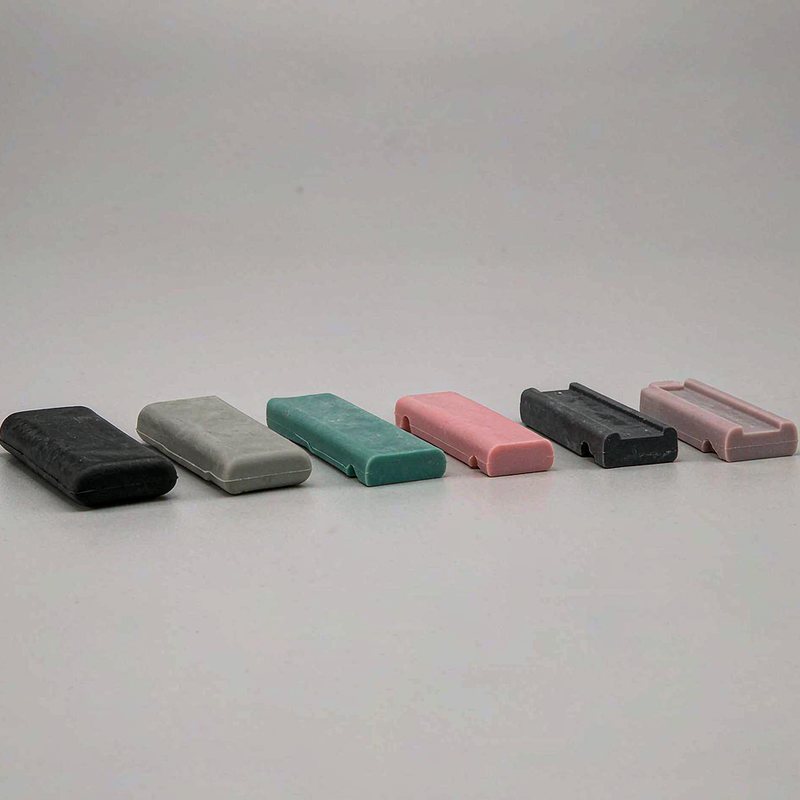

Soft-touch TPE is usually sold as an overmould: a rigid core with a TPE skin, which is the right answer for a handle or a grip. But a large family of parts is pure TPE with no substrate at all: the parts that are soft all the way through, that bend, that squish, that have to feel like nothing else in the programme. Those parts are quoted differently, tooled differently and verified differently, and treating them as overmoulding without a core is the mistake that shows up as a part that tears at the gate or sticks in the tool.
We mould pure-TPE soft parts at shore 0 to 30 A with Pantone colour matching, for consumer, device and accessory programmes.
What changes without a substrate
Three things change when there is no core. First, the part has to be ejected from a soft state, which means the tool is cut with more draft, deeper undercuts are ruled out, and the ejector system is designed to push a part that has no rigidity to push against. Second, the gate is a tear waiting to happen: a soft TPE part with a poorly placed gate tears at the gate under a modest pull, so gates are located where the trim witness lands on a non-functional surface and are trimmed with a cryogenic or die process rather than by hand. Third, the part has no core to hold its shape in the tool, so cooling is the cycle: the tool runs with conformal cooling and the cycle is set by the thickest section, not by the fill.
Hardness selection at the soft end
- Shore 0 to 10 A. Gel-like; used where the part has to conform to a surface. Moulded in low-viscosity SEBS-based compounds, with the cycle dominated by cooling.
- Shore 10 to 20 A. The workhorse of the soft-part family: squeezable, elastic, and still ejectable from a tool with the right draft.
- Shore 20 to 30 A. The firm end; holds detail and can carry a snap feature, at the cost of the conformability that drove the choice of TPE in the first place.
Specification
| Hardness | Shore 0 to 30 A, verified per lot |
|---|---|
| Material | SEBS-based TPE, phthalate free |
| Colour | Pantone matched, delta-E per quality agreement |
| Draft | Minimum 3 degrees per face, substrate-free ejection |
| Gate trim | Die or cryogenic, no hand trim on functional faces |
| Packing | Interleaved, dust-controlled |
| MOQ | 5,000 pieces per part number |
Colour matching at the soft end
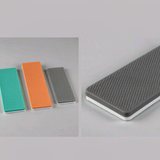
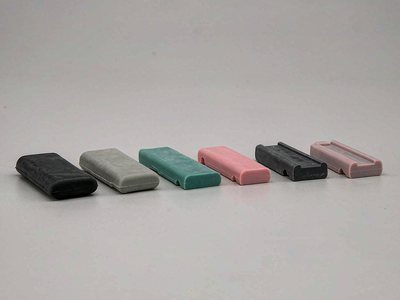
Soft TPE carries pigment differently from rigid plastics: the same pigment load reads lighter on a 5 A compound than on a 30 A one, because the soft compound scatters light differently. A Pantone match is therefore run against the production hardness, not against a master chip, and the physical master is held per programme with a delta-E target stated in the quality agreement. Programmes that change hardness mid-season re-run the match, and we say so on the quote, because a colour that was approved at 20 A is not automatically approved at 10 A.
Compliance
SEBS-based compounds are phthalate free by construction and declare to REACH for the material stream, with the pigment system declared per programme. Where the part is handled as a consumer item, the programme's own specification becomes the audit document, and we quote against that written specification. Food-contact and skin-contact declarations are available on request for the compound grades that carry them, and the declaration names the material lot so the buyer's file is complete without a laboratory reference.
Related reading
Our TPE overmoulding programme covers the two-shot family, and the TPE products category lists the full range.