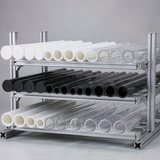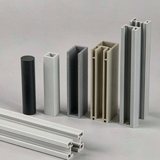





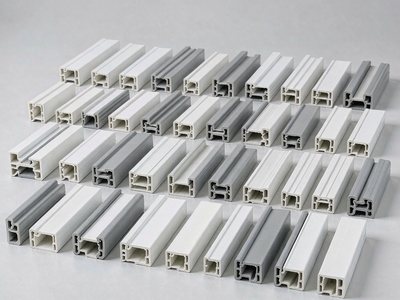

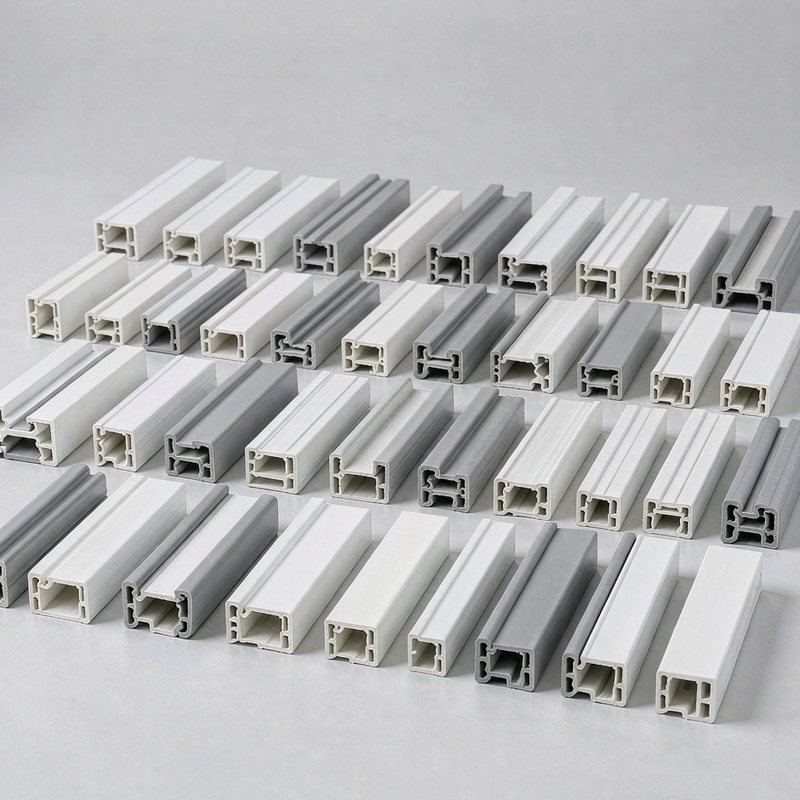

A co-extruded profile is two materials through one die at the same time, and the result is a part that neither material could be alone: a rigid core with a soft sealing edge, or a decorative profile in two colours with no assembly step. The process is quoted by capability rather than by material price, because the difficulty is not the extrusion; it is holding the bond line and the dimension across the whole length, every length, for the life of the programme.
We co-extrude profiles in dual-colour and soft-hard combinations for sealing, trim and decorative programmes.
The two families
- Soft-hard. A rigid core, usually PVC or PP, with a TPE edge moulded onto it in the same pass. Used for sealing profiles, edge trims and bumper applications where the rigid part carries the geometry and the soft part carries the seal. The bond line is the specification: a soft edge that delaminates at a corner is a die problem, not a material problem.
- Dual-colour. Two colours of the same material family through one die, for decorative profiles, identity trims and two-tone sealing profiles where the colour split is functional. The split is a die decision and cannot be adjusted at the press afterwards.
Bond line control
The bond between the two streams is set at the die, where the two melts meet and knit. The knit quality depends on the temperature match at the interface, the pressure the two streams meet under, and the flow balance across the die width. All three are die and process decisions, and the verification is a peel or a tensile test on the bond line per lot, because a profile that peels at the interface after a week in service was under-bonded at the die, and no downstream step re-bonds it.
Specification
| Soft-hard | PVC or PP core, TPE edge, bond verified per lot |
|---|---|
| Dual colour | Same family, two colours, colour split per die |
| Cross-section | Up to 120 mm width, per programme drawing |
| Length | Cut to length, tolerance plus or minus 1 mm |
| Tolerance | Plus or minus 0.15 mm on the critical dimension |
| Rigidity | Shore D core, Shore A edge, declared per lot |
| MOQ | 3,000 metres per profile |
Dimension control on a continuous part
A profile is judged on its cross-section, and the cross-section drifts along the length as the die and the cooling trough wear. The control is a sampled dimensional check per lot on the critical dimension, with the sample pulled from the start, the middle and the end of the run, because a profile that gauges at the start and drifts at the end is a calibration problem that shows up as a fit problem on the buyer's line. We report the three-position check on the lot card rather than a single average.
Secondary operations
Co-extruded profiles usually leave the line cut to length, and the secondary operations the category needs are drilling, notching and end-forming, all of which are quoted as a separate operation per profile. Where the programme needs a flexible section in an otherwise rigid profile, a flex-notching pattern is machined in rather than a second extrusion, which is the cheaper route at the volumes this category runs at. The notching is quoted per metre with the pattern agreed against the buyer's bend radius.
Compliance
Co-extruded profiles declare to REACH for both material streams, and the declaration covers the core compound and the edge compound as separate lots because each migrates differently. UV-stabilised grades are quoted for outdoor trim programmes with the stabiliser package declared, and programmes that sell into the EU carry the phthalate declaration for the PVC core where the grade requires it.
Related reading
Our extrusion profile programme covers the single-material family, and the profiles category lists the full range.