





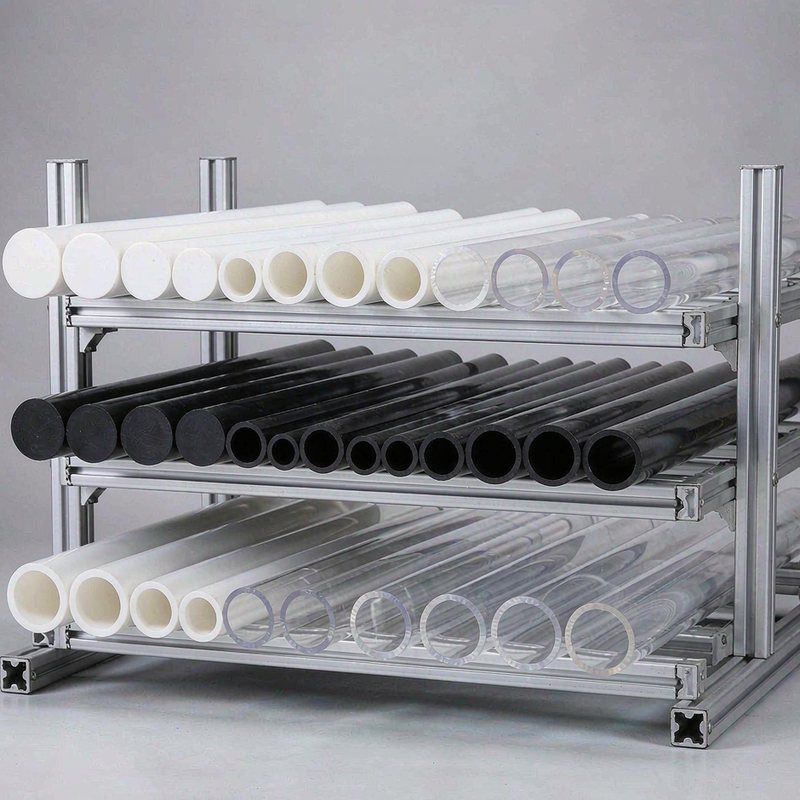

Stock rod and tube look like a commodity purchase until the parts start failing. A roller cover that warps after machining, a bushing that binds because the bore was cut before the stress relaxed, a tank window that crazes at the drilled holes: all three come from the same root, and it is not the extrusion.
We extrude and supply plastic rod and tube cut to length, with secondary machining performed from annealed stock and a stated tolerance.
What the extrusion controls
Rod and tube are extruded through a die and cooled in a calibration bath, and the tolerance that matters is not the diameter alone but the concentricity: a tube whose wall is thick on one side will not hold a bore and a rod that is slightly oval will run out when turned. Diameter is held to h9 or h11 as the programme requires, and the concentricity is stated in the specification rather than left to the die.
Why machining changes the material
Extruded stock carries residual stress from the die and the cooling. A rod machines true and then relaxes over the following hours, moving out of round or bowing. The fix is annealing: the stock is heated to just below its softening point and cooled slowly, which relaxes the stress before the machining rather than after. Every machined part in this programme is cut from annealed stock, and the annealing is stated in the spec so the buyer knows why the lead time is what it is.
Specification
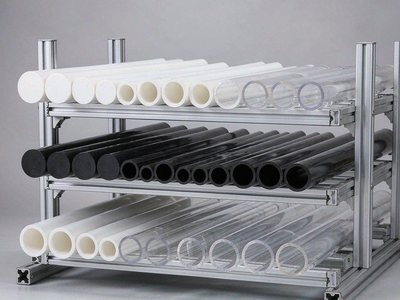
| Materials | PVC, PP, PE, ABS, PC, PMMA, PA |
|---|---|
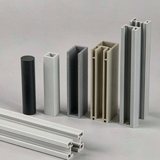
| Forms | Solid rod, tube, channel bar |
| Diameter tolerance | h9 or h11 as quoted |
| Cut length tolerance | plus/minus 0.5 mm |
| Machining | Drilling, milling, turning, from annealed stock |
| Surface | As extruded or machined finish |
| MOQ | 1,000 pieces or 500 kg per material |
Material selection by application
- PVC. Chemical resistance and price; the default for tanks, ducting and fittings.
- PP and PE. Food contact and wet environments; weldable, flexible at low temperature.
- ABS. Machinability and surface finish; the default for visible covers and rollers.
- PC. Impact and clarity; windows, guards and sight glasses.
- PMMA. Clarity with better scratch resistance than PC; display and lighting parts.
Common applications
Roller covers and idler rollers turned from PP or ABS, bushings and spacers from PA or POM, tank and vessel windows from PC or PMMA, and pump and valve bodies machined from PVC bar where a moulded body would need a tool the volume does not justify. The machined-from-stock route is the right answer for dozens to a few thousand pieces and the wrong answer above that, which is why the quote states the volume at which a moulded part becomes the cheaper option.
Cutting and packing
Cut-to-length is quoted with the tolerance stated, because a tube cut on a chop saw splinters at the exit face and a tube cut on a latere-cut or a fine-tooth saw with support does not. Bundles are capped so the cut ends do not chip in transit, and the pack is sized to the diameter: a bundle of 25 mm rod travels fine, a bundle of 100 mm rod needs end caps and a rigid carton or the ends arrive chipped.
When moulded beats machined
The honest answer at quotation: machined parts from stock are cheaper up to roughly 2,000 to 5,000 pieces depending on the part, and more expensive above it, because the stock cost is paid on every piece and the machining is paid on every piece. Where a programme is growing, the quote includes a moulded alternative with the tool amortised, so the buyer can see the crossover rather than discovering it at reorder.
Related reading
Our custom extrusion profile programme covers the profile angle, and the extruded profiles and rods category lists the full range.