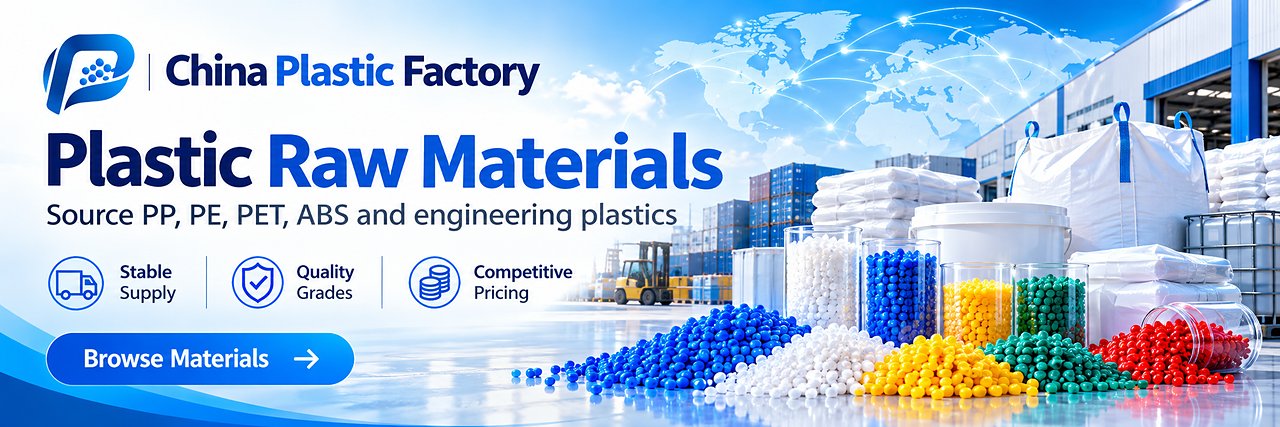
Plastic materials are the resins and compounds a part is actually made from, and the grade you choose decides its strength, heat resistance, surface finish and the compliance paperwork you can hand to a customer. This section lists PP, PE, PVC, PS, ABS, PET, engineering resins and bio-based compounds offered by suppliers on China Plastic Factory. Compare grades, then send a buying request with your target properties.




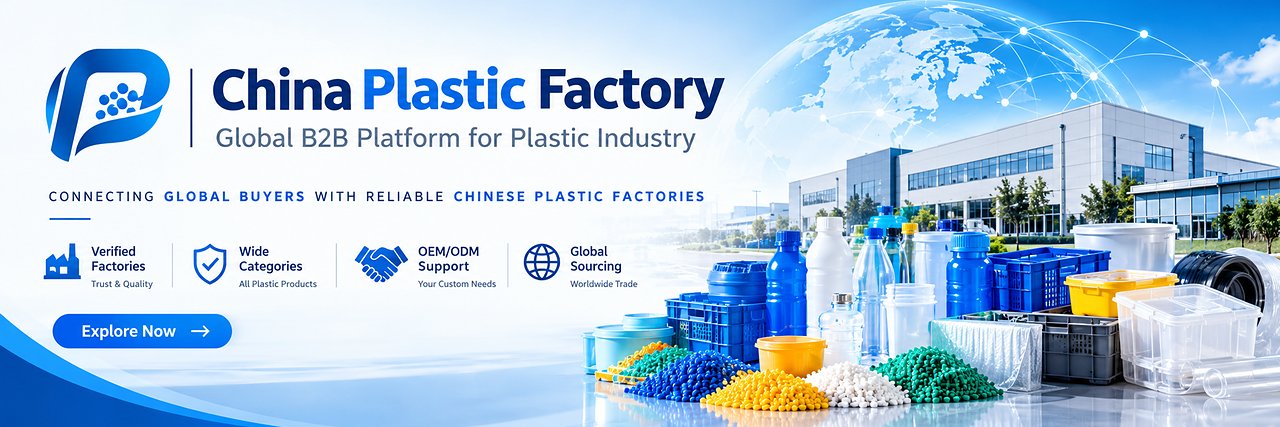
Two quotes for the same "PP" can differ by a factor of three in price and behave nothing alike in production. The difference is almost never the resin family — it is the grade: its melt flow, its filler loading, its impact modification and the certificates that ship with it. Buyers sourcing from Chinese compounders and distributors usually narrow the field on four things: the processing method the part needs, the service temperature, the surface and colour requirement, and the compliance regime the finished product falls under.
| Family | Typical use | What to specify first |
|---|---|---|
| PP (homopolymer / copolymer) | Containers, caps, automotive trim, housewares | Melt flow rate, impact grade, food-contact status |
| HDPE / LDPE / LLDPE | Bottles, film, pipe, crates | Density, MFI, film gauge or wall thickness |
| PVC (rigid / flexible) | Profiles, pipe, cable, sheet | Plasticiser type and phr, stabiliser system |
| ABS / PS / SAN | Housings, appliances, toys | Impact strength, gloss level, flame class |
| PET / rPET | Bottles, sheet, fibre | Intrinsic viscosity, food-grade certification |
| PA, POM, PBT, PC | Gears, housings, connectors, lenses | Glass or mineral loading, moisture conditioning |
| PPS, PEEK, PEI, PSU | Under-hood, electrical, medical | Continuous service temperature, UL yellow card |
| PLA, PBAT, PHA, starch blends | Single-use packaging, film | Certified compostability standard, shelf life |
A purchase order that says "PP, white" leaves the supplier free to ship whatever is in stock. State the parameters that drive your process and your part:
Compliance paperwork is where cheap offers fall apart. Ask for these with the quotation, not after the deposit:
It depends on whether you buy compound or resin. Compounders often quote from one 25 kg bag for a sample and from one pallet or one tonne for a production run, while polymer producers and authorised distributors typically sell full 25 kg bags by the pallet or the 20-foot container. Always confirm whether the quoted price is FOB, CIF or EXW, and whether the MOQ applies per grade or per order.
Ask for the lot number, the COA that matches it, and the original packaging in photographs before shipment. Request a third-party test — MFI, density, ash content and DSC are enough to separate virgin from heavily reprocessed material — and make acceptance conditional on that result.
Yes, but the certificate must cover the specific grade, not the resin family. Ask for a declaration of compliance that names the grade, states the migration test conditions, and is issued for your destination market. Keep in mind that food-contact status can be lost in processing if you add non-compliant masterbatch or regrind.
It means the compound contains roughly 30% glass fibre by weight, but the properties still depend on fibre length retention, coupling agent and the base resin. Two 30% GF nylons can differ by 30% in tensile strength, so ask for the data sheet rather than assuming equivalence.

 Site name:China Plastic Factory
Home About us Contact Use Agreement Copyright Privacy | sitemap | Rank | Advertising | gift | guestbook | RSS
(c) 2026 China Plastic Factory. All Rights Reserved.
